Showing posts with label Somaliland. Show all posts

Friday, 16 August 2013

The Sixth Hargeisa International Book Fair - Day One

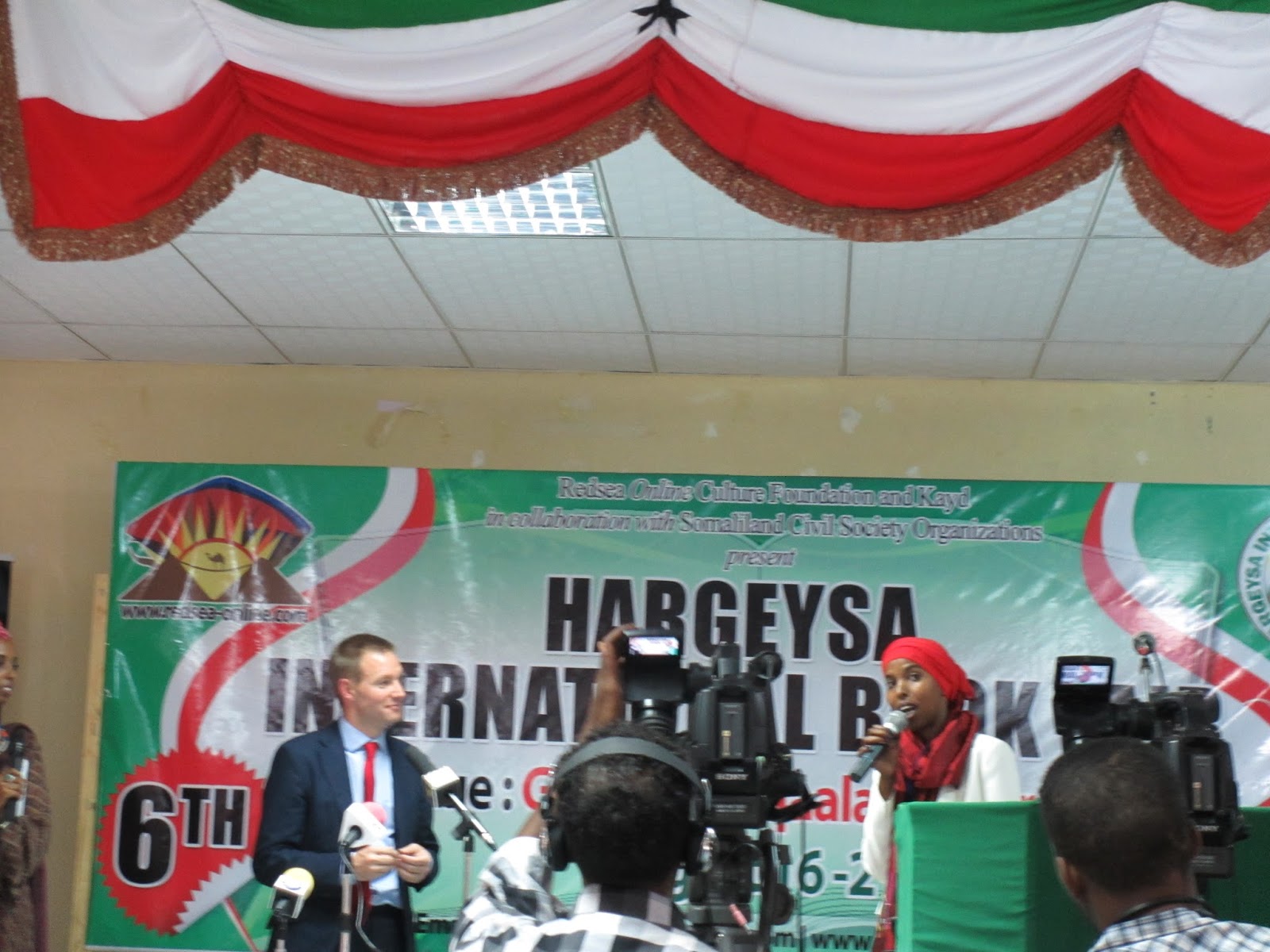
This year's Hargeisa International Book Fair is bigger than ever. The theme is 'Journey'. Kenya is the guest country. There are Somali authors, academics, poets, singers, dancers, photographers and artists in abundance. Plus those from many other parts of the world
including Nigeria, Djibouti, Kenya, Holland, Italy, and the UK. And a supermodel from Czechoslovakia. 

Click this link to see the programme of events: Hargeisa Book Fair 2013 


The first day started with the national anthem and a welcoming speech by the organiser of the fair, Jama Musse Jama. And the Nigerian author, Chuma Nwokolo, noticing what some of the Somali men were wearing: A Sartorial Hargeisa

There was standing room only as the great Somali poet, Hadrawi, recited Sirta Nolosha (Life's Essence).


Standing room only for Hadrawi
Hadrawi in full flow
Hadrawi

Some funny looking men appeared, thick set and wearing earpieces.

Confused looking man arrives at the book fair
Photographing the confused looking men
It turned out these confused looking men were bodyguards for the new British ambassador to Somalia, Neil Wigan, who turned up with a delegation from the British government's aid body DFID. He gave a speech in Somali.

He then spoke in English, talking about the deep links between Somaliland and the UK. He said the Somali community was one of the oldest in Britain, with its roots going back more than a century. He said "we in the UK are enormously proud of the Somaliland community", mentioning the journalist Rageh Omar, the runner Mo Farah and the author Nadifa Mohamed. He said the book fair was an example of the energy and talent in Somaliland, and its encouragement of reconciliation and cooperation across the region. He added that it gave a "hugely positive image" of Somaliland to the outside world.

Organiser of the book fair, Ayan Mahamoud, then stood up and said she had two requests, even though she understood that the ambassador couldn't give any comments.

1. The ambassador's support in resolving the crisis facing Somali remittance companies in the UK due to Barclays' decision to withdraw banking services.

(Someone in the crowd shouted out that Mr Wigan should comment on this issue, and there was a general sense of stirring in the room)

2. The ambassador's recognition of the peace and development in Somaliland.

The British ambassador speaks Somali

There's that confused looking man again

Monday, 24 June 2013

Somalia's lifeline under threat

I started this blog post in 2013, following a decision by Barclays Bank in the UK to close the accounts of Somali and other remittance companies. The problem has spread to other countries, most recently the US where on Friday 6 February 2015, the main bank providing services to Somali money transfer companies, Merchants Bank of California, closed their accounts.

Initially, the US-based Somali remittance companies suspended operations - but on 28 February they said they would restart operations, albeit in limited form. How will they do this?  By carrying cash. I have highlighted the relevant part of the press release.


          Statement of the Somali American Money Services Association.
                                      Press Release
 February 28, 2015

Since Merchants Bank of California terminated the accounts of Somali American Remittance Companies on February 6, transmission of family support money to the needy Somali people in East Africa grounded to a halt. Remittance companies lost the bulk of their wiring capabilities and were forced to drastically scale down their services in many states and completely shut down in many others.
For a long time, the Somali American Money Services Association (SAMSA) had been reaching out to US regulators, elected officials and other Government officials by warning of an impending humanitarian crisis in the Horn of Africa if the un-banking of remittance companies was not resolved. Unfortunately the situation appears to have come to the precipice SAMSA and its advocates have been warning of. SAMSA wishes to convey its utter disappointment that, at the moment, there is nearly no sustainable channel to wire money to the desperately poor people of Somalia – unless hundreds of millions of dollars a month are packed in suitcases and physically transported across continents.
In recognition of the magnitude of the problem, Members of the US House of Representatives and Senate met with the State Department and Regulatory Agencies on February 26, 2015 in an effort to find a solution to this critical problem. SAMSA wishes to express its dismay that this high profile meeting could not identify a single possible short term solution to this crisis. We wish to share not only our disappointment but our conviction that there is surely a way to maintain this lifeline to the Somali people.
For SAMSA members, remittance is not just a business; it is personal. We run a service that is the single most important component of the Somali people’s livelihood. For millions across East Africa, the $150-$200 a month remittance means the first and last line of defense against starvation and homelessness. It is what ensures the children we left behind continue to have food on the table. It is a vital bulwark against that next, ever-looming man-made famine.
Considering the magnitude of the potential humanitarian crisis, the Remittance Companies have resolved to resume their services in a limited capacity on March 1, 2015, even if it is only possible for a few weeks or months more with the unsustainable options that remain for transporting money. The plan is to utilize the last remaining option available to us (carrying cash abroad in person), no matter how unsafe or antiquated, to deliver money until it, too, is no longer available. In all likelihood, this desperate option will not last for more than a month or two, but it will be worth it if we can prevent an avoidable, artificial famine even for a day longer.  Not only is this method too costly and unsustainable, it also is likely to result in the loss of nearly 50% of transmissions, as Money Transfer Companies will stop operating in many regions due to the fact that it will be unrealistic to transport money from them. We estimate that, with the limited capacity, these efforts will result in the resumption of only about 50% of transmission volumes.
Meanwhile, SAMSA continues to believe in the willingness of the United States, its regulatory Agencies and elected officials to find a lasting solution to this problem. In Particular, US Treasury and State Department cannot afford to continue taking this lightly. It is our belief that the US Government does not intend for this money transfer shutdown, or its inevitable humanitarian, economic, security and political consequences, to transpire.
Finally, SAMSA wishes to appreciate the efforts of elected Members of the US House of Representatives, Senate and the Humanitarian Organizations that continue to advocate on behalf of the millions of Somalis who face an uncertain future without remittances.

END
Contact: Abdulaziz Sugule, 612-481-4446, amsassoc@core.com;

Aden Hassan, 651-434-3697, adenhassan@outlook.com


Monday, 13 May 2013

The other Somalia Conference


Here is a From Our Own Correspondent I did for the BBC about the 'real' Somalia Conference. You can listen to it here. It's the one broadcast on 11 May 2013.

(INTRODUCTION) On Tuesday May 7 2013, delegates from more than fifty countries and international institutions gathered at Lancaster House in London for a big conference on Somalia. It was hosted by the British Prime Minister, David Cameron, and the new Somali president Hassan Sheikh Mohamud. The conference ended with donors promising support for efforts to transform Somalia from conflict-ridden ruin into a functioning nation state. But Mary Harper felt that it was another Somali event, also held in London, that deserved the attention:

The day after the Somalia Conference. The heads of state had made their speeches. Hundreds of millions of dollars/ pounds of extra money had been pledged. The journalists had packed up their cameras and tape recorders. The cleaners were vacuuming the corridors of Lancaster House.

But in another equally glamorous location, another Somalia Conference was taking place. And this was the one that, in many ways, really mattered. Because this was about business and investment.


The British Museum - home to ancient and precious objects from all over the world - was an odd choice of venue. Somalis are traditionally a nomadic people. Apart from livestock, the less you have in terms of material possessions, the better.

This also applies to the Somali business community, a super-globalised group who travel the world, living out of suitcases and making money.


They were there in force in the British Museum. As were the Americans, the Europeans and the Arabs, all keen for a stake in Somalia.  A country that has been at war for more than two decades, its cities smashed to rubble, needs new buildings, roads, electricity and water. And it's in a part of the world where fresh reserves of oil and gas are being discovered.

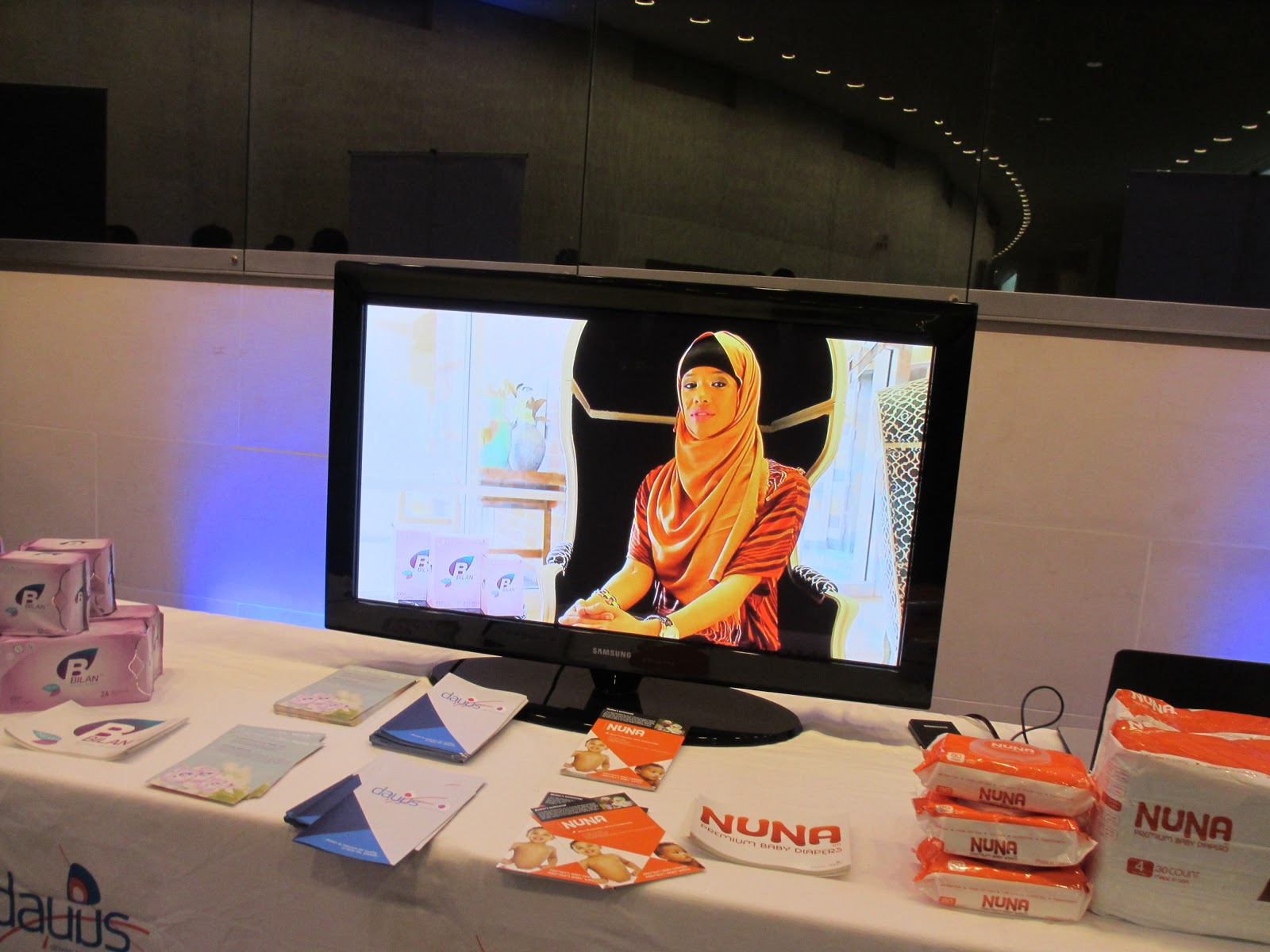
The first thing that caught my eye was an enormous orange banner with a picture of a fat smiling Somali baby wearing nothing but a nappy. Standing in front of it was a smart young Somali in a shiny suit. His name was Mohamed. And he was selling nappies. Made in America. Sold in Somalia.


Mohamed


The company was set up by a group of Somalis living in Minnesota in the United States - home to a huge community of Somali refugees. It was inspired by a young Minnesota-based Somali woman who, every time she went to Somalia, got frustrated by the lack of nappies, sanitary pads and other such items.


So, like a good Somali, she saw an opportunity. The products have Somali names and images. They are a Somali brand. And they are selling like crazy in Somali towns.
Mohamed told me that a recent study found that thirty per cent of teenage girls in Somalia miss school for a few days every month when they have their periods. The products he sells means they don't have to miss school any more.


I could have talked to Mohamed for hours, but I was interrupted by a tap on the shoulder. Someone wanted to introduce me to another Somali entrepreneur called Faisa.

Faisa is small, dainty and extremely pretty. Her leopard skin headscarf made her golden skin glow even more, lips painted a bright and shiny red.

Fails
She was bubbly and dynamic and had a strong Yorkshire accent. She told me how her family had fled Somalia when civil broke out in 1988. They ended up in the British town of Sheffield in South Yorkshire, hence the accent.


Faisa is doing the opposite of Mohamed. She is exporting goods from Somalia to Europe, the Gulf and elsewhere.

Although it is best known for conflict, famine, piracy and extremism linked to Al Qaeda, Somalia also exports more live animals than any other country in the world. Sheep, goats, cows and camels.

Because Somalia is so hot, the animals have thin skin. This means the leather they produce is of the finest quality, and is used to make fine, supple, soft leather goods such as gloves and handbags.

So this dainty young lady from Sheffield is in talks with some of the world's most prestigious leather companies. She was born in the Somali town of Burao, famous for its livestock. And she knows all about animals and their hides.

She rattled off a long list of tanning methods, and told me her company is investing in a Somali tannery, so the hides can be properly treated at source, instead of the current salt and sun drying method.

But Faisa hasn't stopped at leather. Somalia is also home to special trees whose sap produces frankincense and myrrh. For centuries, these have been exported from Somalia for use as incense in mosques and churches, for perfume, cosmetics and other purposes.
It is currently exported in its raw form. Faisa wants to purify it in Somalia, so more of the profits stay in the country.

After meeting Mohamed, Faisa and many others like them, I wondered why the speeches and politics of the previous day had got all the attention. They felt like a lot of hot air. Unlike the Somali company selling affordable nappies and sanitary pads in Somalia where they are much needed. Or the fine gloves, bags, coats and shoes being made from Somali leather. These felt like real things bringing real benefits. Not just to Somalis but to many other people too.

Sunday, 28 April 2013

Somalia Conference in London (Take Two)

It feels a bit like déjà vu. It feels a bit like last year. Another big Somalia Conference is being held in London - last year it was on February 23, this year it's on May 7. It's being held in the same venue, Lancaster House and, just like last year, lots of heads of state and other bigwigs have been invited.

British officials keep telling me this conference is different. Unlike the one last year, which was hosted by the British prime minister, David Cameron, this one will be hosted by both Mr Cameron and the (relatively) new Somali president, Hassan Sheikh Mohamud.

Some British officials are so keen to stress that the conference is, in part at least, 'Somali owned' that large Somali flags emblazon the bottom of their emails. Sometimes I get confused, and think I have received an email from someone in the Somali government, not the British one.


Somali flags emblazon the bottom of emails from British officials

And, just like last year, the UK has caught Somali Fever. A seemingly endless series of Somali-related events has been organised, ranging from posh dinners with the president to angry protests by angry self-declared Somali states.

The conference itself has three main aims:

1. The Somali government is expected to 'share its plans' for developing Somalia's military, police, justice sector and public financial management systems.

2. The 'international community' is supposed to reach an agreement on how to support the implementation of the Somali government's plans.

3. The Somali government is expected to outline how it plans to resolve the outstanding political issues within Somalia (does this include Somaliland, or does it refer to other 'issues' including Jubbaland, Puntland, Galmudug, Khatumo State, areas controlled by Ahlu-Sunna-wa-Jamaa, areas controlled by Al Shabaab, areas occupied by pirates, areas 'secured' by Ethiopians, Kenyans, Burundians, Ugandans, Sierra Leoneans, Djiboutians, Nigerians, Bancroft, etc, etc?).

The conference is also expected to:

4. 'Welcome' dialogue between 'the Federal Government of Somalia and Somaliland' to 'build trust and cooperation. (The two presidents met recently in Turkey, but Britain has been finding it difficult to convince Somaliland to come to the conference).

5. Endorse the UN Security Council resolution which extends the mandate of AMISOM forces in Somalia.

6. Endorse another UN resolution mandating a new UN mission for Somalia. (I wonder what will happen to the head of UN mission, Augustine Mahiga?)

7. Agree what it calls a 'package of support' for Somalia on preventing sexual violence. (Remember a Somali woman was this year jailed in Mogadishu for saying she had been gang raped by members of the Somali armed forces - she has since been cleared of the charges and released. One of her alleged crimes was insulting the government.)

8. 'Hear the latest' on the Somali government's maritime strategy.

9. 'Emphasise the importance of the orderly and voluntary return of refugees to Somalia' and 'look forward' to an event on this issue to be hosted by Somalia, Kenya and the UN. (Kenya last year ordered Somali refugees to leave urban areas and go to the huge Dadaab camp in the east of the country. The UK, US and other countries are also hotting up on efforts to deport Somalis.)

Of course, the conference will have to have an 'outcome'. I expect the 50 or so countries and organisations will pledge their support for the initiatives discussed in Lancaster House, and perhaps offer some more money. But Somalia is featuring in so many big international events this year, that the London Conference will probably only be able to offer a relatively small slice of the cake. Other pledges and financial commitments have to be saved up for the other big meetings later this year, including the Tokyo conference on African development and an EU conference on a new deal for fragile states (which Somalia has already embraced).


Thursday, 7 March 2013

Somali Talk in Whitechapel


I am speaking about my book and other Somali issues from 1-2.30 pm on Saturday 9 March at The Idea Store in Whitechapel. The address is 321 Whitechapel Road, London E1 1BU.

Please come if you can. Light refreshments will be provided and copies of my book will be available for sale and signing.

More details are available by clicking here: Idea Store Events

The event went very well, with lots of lively discussion afterwards, especially about the role of women in Somali society. 


Saturday, 23 February 2013

Transcript of my interview with Somali president


Here is a transcript of an interview I did with the Somali president, Hassan Sheikh Mohamud in London on 3 February 2013.


You are now in London as part of your ‘world tour’. How are your international visits going?

The international community has been with Somalia for more than 22 years but now this is a time that Somalia is different. Ending the transition, permanent government, new vision – this is what we have brought to the international community. I have been in America, in Brussels and this is the third place in the West I have been to.

I think I wouldn’t be wrong in saying you have one of the most difficult jobs in the world, being president of Somalia. Would you agree with that assessment?

Yes I do. Somalia is a unique country. There is no other experience like that anywhere else in the world, particularly in the post-conflict environment. I know that it is that level of difficulty, and when I was standing for the election I was aware of that, and that I had a challenge to face.

The morning after you had been elected, when you woke up, and you realised you really were the president of this broken country that hasn’t had an effective government for more than two decades, were you scared? Did you feel ill? Were you excited?

Well, I was preparing myself for this position for the past 22 years that I was in Somalia, because of learning and knowing what is Somalia. Being a researcher, being a peace-builder, being a civil society activist, being an academician and a teacher in Somalia… And for the last two years I was actively involved in politics, preparing myself to take the position, so I was not scared when I became president. But I sensed the real challenge I was facing, and proof of that was on the second day after I was elected, I was attacked by suicide bombers. So I was aware of the seriousness of the matter. But even then I am quite satisfied and quite confident that I can do it.

You have been president now for several months, since September 2012. If you had to give yourself a mark out of ten about how you are doing, what mark would you give yourself?

These past couple of months have been preparatory. We have been working to prepare the ground. I would give myself about 90 percent. 90 percent of the activities I have been involved in have proven to be successful or promise to be successful soon.

And what’s the 10 percent that has been a failure?

That 10 percent is the time-consuming issue of building institutions, and that’s where we have been lagging behind schedule for the past five months.

How can you really be called president of Somalia when you as president and your government and security forces don’t control even half of the country? You control Mogadishu and a few other areas. The rest belongs to other people, so how can you rightfully have the title of president of Somalia?

The case goes back to the idea of the cup being half full or half empty. Somalia has been in a situation whereby, in 12 years of transition, the government was controlling Mogadishu only and sometimes even a very small strip of Mogadishu. This is a time when the Somali government is getting out of Mogadishu and controlling a number of districts and regions, that’s number one. Number two, I feel a legitimate president of Somalia because I came out of a process whereby all Somalis got together and agreed to move in that direction. We still have many obstacles and many activities to do but my legitimacy is not questionable because it was consensus based. It was not one man one vote but it was through a consensual process, and I came out of that consensus. So far our movement at building the Somali polity is still based on consensus and we are working on that.

You are not afraid that some of the old guard, the wily, experienced politicians of the past, who basically have their own private armies, are going to come back to try to destroy you?

The matter is the other way around. The Somali people have been in this situation and have developed a lot of experience. A lot of lessons have been learned. The matter is the society. These warlords and difficult people you are describing, they were enjoying the support of the community, the local people. Now this is something myself and my government are enjoying, getting popular support. It is the people’s mindset that has changed now. We have had a sort of paradigm shift. We are moving away from the old practices, old beliefs and old ways of doing things, and this is what makes people believe we are pushing the country in the right direction. Whoever gets the support of the ordinary citizens will be the ultimate winner in Somalia. The warlords, Al Shabaab and others, they somehow cheated the people. Now this is the time the people have tried many different options and those options never delivered. This is a time that the people are convinced that the only way out they have is to have a functioning state in place, and that is what I am leading now.

What about Al Shabaab? They have left most of their urban strongholds but they are still very much present in rural areas. Is the best solution to talk to them or try to defeat them militarily?

To defeat the militarily is absolutely very, very important, or to weaken them which is already done. There are two different ways. The boys and the girls who have joined Al Shabaab for different reasons, for different root causes are Somalis citizens who deserve to get back. But the ideological core team who brought the idea of Shabaab and the idea of extremism to Somalia, since they don’t have any political agenda, I don’t see what we have to negotiate with them. There is no political capital that we can have over them. This is an extremist group with an ideological background. We will negotiate with the community elders, the religious scholars and the civil society to attract and give space to those young boys and girls who joined Shabaab for different reasons. But the core team and the foreigners who have no political agenda. Any Shabaab member who denounces violence and comes up with a political agenda, we can negotiate with them and we can accommodate them. Those who are not criminals by their activities of the past, it is very delicate. So far we don’t see any issues we can negotiate with them. We cannot negotiate with Al Shabaab when they say the country belongs to all Muslims, when they say that foreigners rule the country, when they say they will use violence as a means to an end. These are very, very difficult issues that we cannot negotiate. But if they denounce all these issues and come back as Somalis, we can talk to them.

What will you do about the hardliners?

First of all, we have nothing to do with the foreigners. They have to go. If they don’t go, the only option we have is to create an environment or a situation that compels them to go away. Those hard core Somalis, if they denounce their positions, then there is a subject to discuss.

At the moment, Somalia has basically outsourced its security to African Union forces, Ethiopian forces, some Western forces helping. You’ve got foreign navies patrolling the seas to try to get rid of pirates. Isn’t this a massive problem and an embarrassment for you, to have a country whose security is dependent on foreigners?


First of all, when I was coming to this position, when I was seeking the election to become president of Somalia, I was aware of all this. It is there. Many of these issues that you raised, the reason why these different forces are in Somalia is that the Somali problem is not a Somali problem anymore. It’s a regional problem. It’s a continental problem. It’s an international problem. But from our perspective, what we want is to dismantle these interlinking issues and problems that have been established in Somalia for all these long years, and we want to make the challenges in Somalia a Somali problem that Somalis can address. But this will take some time. We will go through a process. We are here today to overtake those forces and control the destiny of Somalia.

How are you going to get the ownership back of your own security?

One of the major reasons we are in London today, and why we have been in Washington and Brussels, is to get the support of the international community to have well-organised, well-equipped, well-disciplined Somali security forces and security institutions. That’s what we are going to build. Once we build that, it will be very easy to take over.

In terms of the arms embargo that’s currently in place, do you want that to be lifted?

Yes, we want to arms embargo to be lifted, and we have requested the United Nations Security Council to do that. We have told the friendly countries we met that we can’t build our security forces if this arms embargo is in place.

And what was their response?

It has been very positive so far. We are just waiting for the final response from the United Nations Security Council.

I have heard some Somalis begin to say – because I suppose the honeymoon period is slightly drawing to an end – that our new president, our new government is very slow. Or sometimes they say it’s like an NGO government. That you are people with good intentions but not politically experienced enough to run this big mess that is Somalia. What’s your answer to your critics?

There is no experience to take for the Somali case. Nobody has ever been in a country or a situation like Somalia so we are all learning, that’s number one. Number two is the complexity of the problem in Somalia means that we can’t hurry or be very fast. We have to be very careful. One simple mistake can take us back many, many years. So we are cautious and we are taking the necessary steps. Somalia has been without a functioning state for 22 years and we want to establish one now. I don’t see any reason how anyone can expect miracles to happen in Somalia in just five months.

You have had some problems with the port town of Kismayo, which was I suppose taken over on your behalf by Kenyan forces backed by Somali troops, but somehow ended up in the wrong hands. A group of people, a clan perhaps. The first attempt your government made to visit the Kismayo, they were not even allowed in. Isn’t Kismayo the latest in a problem of Somali regions not wanting to have anything to do with you.

The case is not that the Somali regions don’t want to have anything to do with us or with the central government. The case is Al Shabaab was there for a long time and AMISOM in collaboration with different Somali forces are there. The Somali government forces are there and other forces are there of course. But negotiations are going on. The Somali government has been visiting continuously in Kismayo. The issue of Somalia and Somali security is not only a Somali issue. It is regional, continental and international. What you are talking about now is only one small example of how intricate and complex is the situation in Somalia. Soon the prime minister will visit Kismayo. We are negotiating with different stakeholders on the ground, including the local people, the elders, the civil society. Soon a local administration will be established in Kismayo. I don’t see any threat or any problem that Kismayo has that is different from so many complex situations that exist in Somalia. Kismayo is no different from Galkayo, Galmudug, Bay and Bakol, and Hiran. It all needs a lot of effort and a lot of local negotiations, a lot of confidence building, and that’s what we are doing now.

Isn’t that precisely the problem? That Somalia is essentially balkanised. You have Somaliland which has declared independence which it says its not negotiable, you have Puntland which is semi-autonomous, all sorts of other regions. Aren’t you frightened that you’re going to end up being the president of Mogadishu, with the rest of the country operating as semi-independent states that don’t respect you?

I don’t deny that that is the reality on the ground now. But one of the reasons I took office is that the vision I have is to bring back all those bits and pieces and make one unified Somalia. That’s the task we are going to undertake. It’s a reality as you said. Some of those areas have been there for twenty years, some are recent, some want to do the same right now, and we are working on them. We want to organise those who are not organised well yet, and we want to negotiate with the others, and those negotiations have started. They are at the early stage but we have already established connections with different entities including Somaliland, Puntland, Galmudug, Ximan and Xeeb. We have already established links with all of them, and negotiations are going on at different levels. It is a matter of time before you see things changing on the ground.

Somaliland has said that its independence is non-negotiable. Would you be prepared to let Somaliland go its own way and become a completely separate country?

We respect the self-determination of the people but Somalia became a united republic in 1960. We have not yet agreed to separate from each other. We may have different views on unity, but from our part, we have no hidden agenda. It is well known – it was part of my campaign, it’s part of my principles, it’s still part of my policies to see a united Somalia. But we don’t want that unity to come through military coercion, through violence, through emotions or diplomatic pressures. We want that unity to come through a dialogue, through understanding. There is a lot of mistrust in place and resolving that mistrust is a long term issue. Today we want to put in place tools and instruments to manage that mistrust, so that in the long term that mistrust will go away. But for us, one of the six pillar frameworks we established was to establish the unity of the country. We are committed and we want to see a united Somalia. We will give it the time it needs to get that goal achieved.

Somalia has been named the world’s most failed state for the past five years in a row. Do you think it’s going to be the world’s most failed state for a sixth year or will somewhere else take its place?

Somalia has been given different names, not only that one. It’s the one with the largest refugee camp, that exports terrorism, the most corrupt, so all these adjectives are there. But Somalia is a different place today, with a different hope, a different leadership and our way forward, our agenda, our vision has been written down – it is there in documents. For the first time in the recent history of Somalia, our people have something to discuss, an agenda, a way forward. We are expecting that another year, two years from now, what we have planned and put in place, and have discussed with the Somali people and with the international community is a different Somalia. We have a very clear picture of the type of Somalia we want. It’s incremental and gradual, but we want to see a different Somalia in 2015 and 2016.


Friday, 28 September 2012

My US book tour


This photo was taken by Geoff Marsh, The Fletcher School


My US book tour of September and October 2012 took me to four cities. I started off in Boston where The World Peace Foundation at The Fletcher School of Law and Diplomacy at Tufts University invited me to give a talk.

The World Peace Foundation organised my book tour and asked no less than five academics to review my book. I also wrote a response to those reviews. I would like to thank Alex de Waal, Bridget Conley and Lisa Avery of The World Peace Foundation for all their help, as well as the engaged and intelligent students of Tufts University who came to my talks, and asked such interesting and challenging questions.

The book event started with a book-signing in The Hall of Flags at The Fletcher School. 
This photo was taken by Geoff Marsh, The Fletcher School

By chance, the Somali flag was hanging near to where I signed my books
Signing books for students
We then moved to a lecture theatre for the presentation and discussion. I showed some photos from my recent trip to Somalia and Somaliland, some of which I hoped would show that there is more to the 'Somali story' than hunger, war, piracy and Al Qaeda, even though all of those things are also present.

Armed man in Mogadishu
Destroyed parliament in central Mogadishu
Opening of the Coca Cola factory in Somaliland
The Somaliland Circus
You can read a piece about my Tufts talk here: An evening with Mary Harper

I then took the beautiful train journey from Boston to New Haven, whizzing through autumn woodland and past grand properties on the coast, sailboats bobbing in the ocean. My second talk was at Yale University, where I was delighted to see several Somalis in the audience, some of whom had driven in from the town of Hartford, where there is a substantial Somali community. One of them read out a quote from a book called 'Warrior' by Gerald Hanley and asked whether I agreed with it. Here is the quote: "Of all the races in Africa, there cannot be one better to live among than the most difficult, the proudest, the bravest, the vainest, the most merciless, the friendliest: the Somalis'.

Yale


Some Somali members of the Yale audience
It is election season in the US so there are lots of poster, billboards, signs, adverts and endless TV and radio talk about Obama and Romney. I saw this giant anti-Obama billboard...


... in the grounds of this petrol station:


Many people enthusiastically display their political affiliations on their front lawns:


After New Haven, I took the train to Washington DC. Some of the poorer neighbourhoods of some of the towns I passed, especially Baltimore, somehow reminded me of parts of Mogadishu. A group of Somalis met me at the grand Union Station in Washington and looked after me the whole time I was in the city. I spoke at the United States Institute of Peace, which is directly opposite the State Department. 


The United States Institue of Peace is a beautiful building. The roof looks like the wings of a dove.
The event, called Whither Somalia?, was so full there had to be an 'overspill room'. The Somali activist, Sadia Ahmed and Deputy Director of the Atlantic Council's Michael S Ansari Africa Centre, Bronwyn Bruton, were on the panel. The chair was Jonathan Temin of the United States Institute of Peace.

Speaking at the United States Institute of Peace
You can watch a video of the event by clicking on this link: Watch the video here

I then headed for New York city where I first spoke at the Centre on Global Counterterrorism Cooperation. This was a closed event. The Somali ambassador to the United Nations was there, as were Kenyan representatives at the UN. The meeting was chaired by Liat Shetret of CGCC.

The next day, Tatiana Carayannis and Ciara Aucoin of the Social Science Research Council organised a marathon day for me. I went to UN headquarters where I held two interesting closed discussions with senior officials working on Somalia. I also spoke at the beautiful, serene Quaker House.

The gardens behind Quaker House, right in the heart of New York city.
This was an open event, attended by different countries' representatives to the UN, NGO officials and friends. The US academic Ken Menkhaus, who has written extensively on Somalia, was the discussant.

Ken Menkhaus and me on the sofa in Quaker House
Good friends came to the event