Showing posts with label Getting Somalia Wrong?. Show all posts

Friday, 16 August 2013

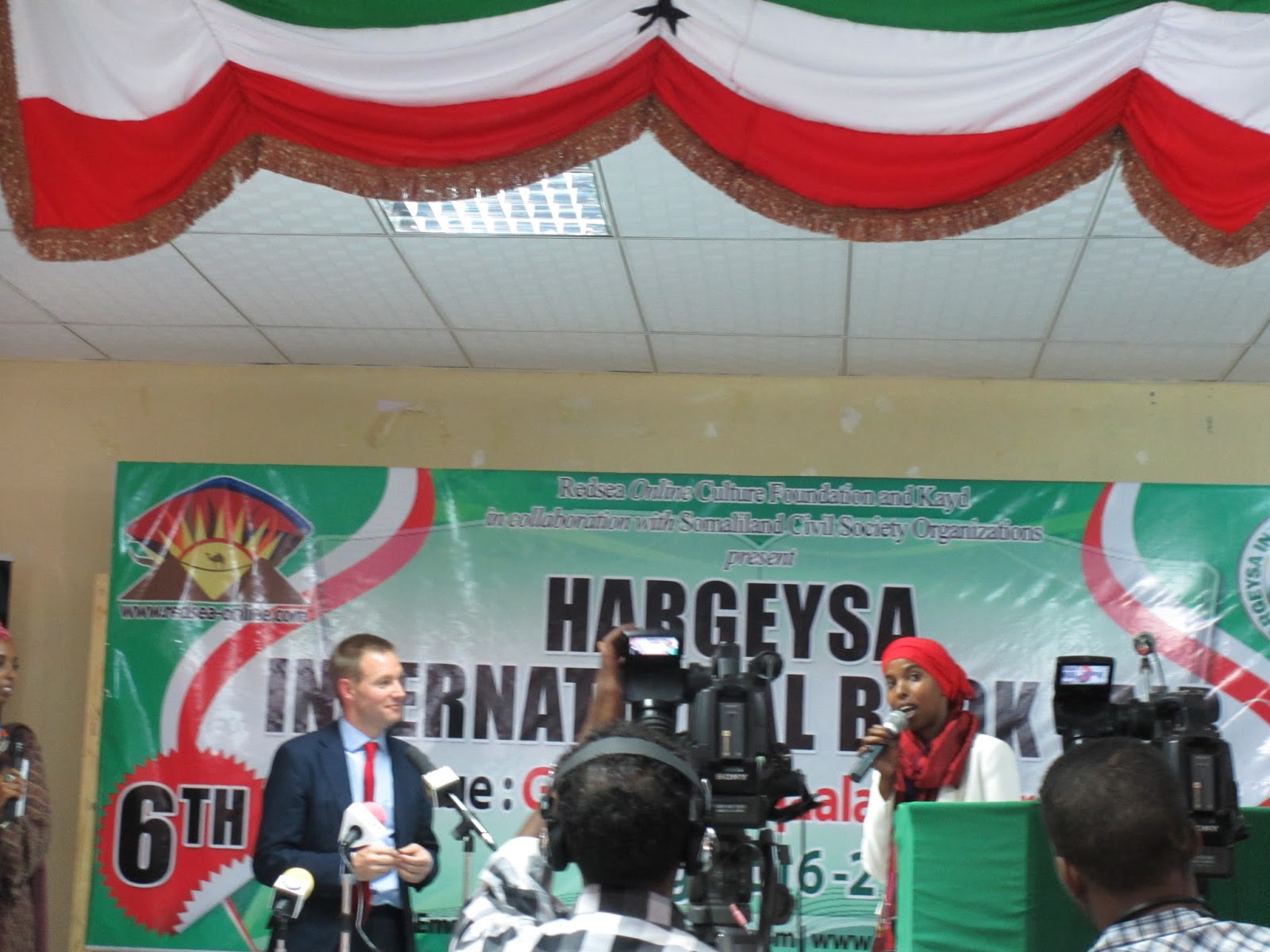
The Sixth Hargeisa International Book Fair - Day One

This year's Hargeisa International Book Fair is bigger than ever. The theme is 'Journey'. Kenya is the guest country. There are Somali authors, academics, poets, singers, dancers, photographers and artists in abundance. Plus those from many other parts of the world
including Nigeria, Djibouti, Kenya, Holland, Italy, and the UK. And a supermodel from Czechoslovakia. 

Click this link to see the programme of events: Hargeisa Book Fair 2013 


The first day started with the national anthem and a welcoming speech by the organiser of the fair, Jama Musse Jama. And the Nigerian author, Chuma Nwokolo, noticing what some of the Somali men were wearing: A Sartorial Hargeisa

There was standing room only as the great Somali poet, Hadrawi, recited Sirta Nolosha (Life's Essence).


Standing room only for Hadrawi
Hadrawi in full flow
Hadrawi

Some funny looking men appeared, thick set and wearing earpieces.

Confused looking man arrives at the book fair
Photographing the confused looking men
It turned out these confused looking men were bodyguards for the new British ambassador to Somalia, Neil Wigan, who turned up with a delegation from the British government's aid body DFID. He gave a speech in Somali.

He then spoke in English, talking about the deep links between Somaliland and the UK. He said the Somali community was one of the oldest in Britain, with its roots going back more than a century. He said "we in the UK are enormously proud of the Somaliland community", mentioning the journalist Rageh Omar, the runner Mo Farah and the author Nadifa Mohamed. He said the book fair was an example of the energy and talent in Somaliland, and its encouragement of reconciliation and cooperation across the region. He added that it gave a "hugely positive image" of Somaliland to the outside world.

Organiser of the book fair, Ayan Mahamoud, then stood up and said she had two requests, even though she understood that the ambassador couldn't give any comments.

1. The ambassador's support in resolving the crisis facing Somali remittance companies in the UK due to Barclays' decision to withdraw banking services.

(Someone in the crowd shouted out that Mr Wigan should comment on this issue, and there was a general sense of stirring in the room)

2. The ambassador's recognition of the peace and development in Somaliland.

The British ambassador speaks Somali

There's that confused looking man again

Thursday, 7 March 2013

Somali Talk in Whitechapel


I am speaking about my book and other Somali issues from 1-2.30 pm on Saturday 9 March at The Idea Store in Whitechapel. The address is 321 Whitechapel Road, London E1 1BU.

Please come if you can. Light refreshments will be provided and copies of my book will be available for sale and signing.

More details are available by clicking here: Idea Store Events

The event went very well, with lots of lively discussion afterwards, especially about the role of women in Somali society. 


Thursday, 21 February 2013

Interviewing the president of Somalia

On Sunday February 3, I was invited to The Dorchester Hotel in London to interview the Somali president, Hassan Sheikh Mohamud. 

I could tell an important Somali was staying in the hotel way before I entered its doors. The nearby streets were full of Somalis, and this was a part of London not normally frequented by large crowds of Somalis. Inside the hotel, guests seemed somewhat bewildered by the fact that all the seats in the foyer were occupied by Somalis. The security guards also looked a bit perplexed.


Somalis take over the foyer of The Dorchester Hotel
I met several good friends in the foyer, and after some lively chats, I was invited up to the president's room. He was generous with his time, so I did quite a long interview with him. I also gave him a copy of my book on Somalia.

You can listen to the version of the interview played on the BBC by clicking here.

To listen to the full version of the interview - nearly 20 minutes - please click here.

Interviewing Hassan Sheikh Mohamud for the BBC

The Somali president with my book

Monday, 7 January 2013

The Jaipur Literature Festival

I was lucky enough to be invited to take part in three talks at The Jaipur Literature Festival in India. The festival took place from 24-28 January at the Diggi Palace in the pink city of Jaipur.

The list of speakers was long and impressive.


Jaipur
Here are the discussions I took part in:
  1. 25th Jan – 2:15pm to 3:15pm
Heaven on Earth: On Sharia Law 

Sadakat Kadri, Tom Holland, Ali Asghar Engineer, Ian Buruma and Mary Harper, moderated by Reza Aslan

Almost 1400 years after the Prophet Mohammed first articulated God’s law – the Sharia – its earthly interpreters are still arguing over what it means. Hardliners reduce it to amputations, veiling, holy war and stonings. Others say it is humanity’s only guarantee of a just society. In Heaven on Earth, Sadakat Kadri, a London-based criminal barrister and prize-winning writer, sets out to see who is right. Tom Holland, Ali Asghar Engineer,Ian Buruma and Mary Harper will examine Kadri’s ideas in a discussion moderated by Reza Aslan.
  1. 26th Jan – 3:30pm to 4:30pm 
Out of Africa

Aminatta Forna, Mary Harper and Anjan Sundaram in conversation with Kwasi Kwarteng

Sometimes Africa seems to make news headlines around the world only for wars, famines and poverty. Four leading writers on the new Africa would beg to differ. Aminatta Forna, Mary Harper and Anjan Sundaram will be in conversation with Kwasi Kwarteng.

Out of Africa panel
  1. 26th Jan - 6pm to 7pm
Falling off the Map: The Question of Failed States

Mary Harper, Reza Aslan, Laleh Khadivi, Selma Dabbagh and Sharmeen Obaid Chinoy, moderated by Barkha Dutt

American right-wing rhetoric makes much of the danger posed by ‘failed states’. Do they exist, or is the whole concept just an excuse for Western neo-colonial intervention? Mary Harper, Reza Aslan, Laleh Khadivi, Selma Dabbagh and Sharmeen Obaid Chinoy discuss the concept with Barkha Dutt.


There was media coverage of some of the events I participated in. Here's a sample:

I was interviewed by The New York Times - you can read it by clicking here.

The Hindu newspaper wrote about the Sharia Law panel - read the article here.

Radiance Weekly also covered the Sharial Law talk - read it  here.

And here's an article that I don't understand:

Here are some photos from the festival and elsewhere in Jaipur:

Entrance to the Jaipur Literature Festival
My beautiful hotel in Jaipur
My book for sale at the festival

Hundreds (if not thousands) of people came to my talks
I was invited to speak to students at a local university


Inside the pink city of Jaipur

Festival organiser and author, William Dalrymple, and Oscar winner, Sharmeen Obaid-Chinoy
Enjoying the talks at the festival

Friday, 28 September 2012

My US book tour


This photo was taken by Geoff Marsh, The Fletcher School


My US book tour of September and October 2012 took me to four cities. I started off in Boston where The World Peace Foundation at The Fletcher School of Law and Diplomacy at Tufts University invited me to give a talk.

The World Peace Foundation organised my book tour and asked no less than five academics to review my book. I also wrote a response to those reviews. I would like to thank Alex de Waal, Bridget Conley and Lisa Avery of The World Peace Foundation for all their help, as well as the engaged and intelligent students of Tufts University who came to my talks, and asked such interesting and challenging questions.

The book event started with a book-signing in The Hall of Flags at The Fletcher School. 
This photo was taken by Geoff Marsh, The Fletcher School

By chance, the Somali flag was hanging near to where I signed my books
Signing books for students
We then moved to a lecture theatre for the presentation and discussion. I showed some photos from my recent trip to Somalia and Somaliland, some of which I hoped would show that there is more to the 'Somali story' than hunger, war, piracy and Al Qaeda, even though all of those things are also present.

Armed man in Mogadishu
Destroyed parliament in central Mogadishu
Opening of the Coca Cola factory in Somaliland
The Somaliland Circus
You can read a piece about my Tufts talk here: An evening with Mary Harper

I then took the beautiful train journey from Boston to New Haven, whizzing through autumn woodland and past grand properties on the coast, sailboats bobbing in the ocean. My second talk was at Yale University, where I was delighted to see several Somalis in the audience, some of whom had driven in from the town of Hartford, where there is a substantial Somali community. One of them read out a quote from a book called 'Warrior' by Gerald Hanley and asked whether I agreed with it. Here is the quote: "Of all the races in Africa, there cannot be one better to live among than the most difficult, the proudest, the bravest, the vainest, the most merciless, the friendliest: the Somalis'.

Yale


Some Somali members of the Yale audience
It is election season in the US so there are lots of poster, billboards, signs, adverts and endless TV and radio talk about Obama and Romney. I saw this giant anti-Obama billboard...


... in the grounds of this petrol station:


Many people enthusiastically display their political affiliations on their front lawns:


After New Haven, I took the train to Washington DC. Some of the poorer neighbourhoods of some of the towns I passed, especially Baltimore, somehow reminded me of parts of Mogadishu. A group of Somalis met me at the grand Union Station in Washington and looked after me the whole time I was in the city. I spoke at the United States Institute of Peace, which is directly opposite the State Department. 


The United States Institue of Peace is a beautiful building. The roof looks like the wings of a dove.
The event, called Whither Somalia?, was so full there had to be an 'overspill room'. The Somali activist, Sadia Ahmed and Deputy Director of the Atlantic Council's Michael S Ansari Africa Centre, Bronwyn Bruton, were on the panel. The chair was Jonathan Temin of the United States Institute of Peace.

Speaking at the United States Institute of Peace
You can watch a video of the event by clicking on this link: Watch the video here

I then headed for New York city where I first spoke at the Centre on Global Counterterrorism Cooperation. This was a closed event. The Somali ambassador to the United Nations was there, as were Kenyan representatives at the UN. The meeting was chaired by Liat Shetret of CGCC.

The next day, Tatiana Carayannis and Ciara Aucoin of the Social Science Research Council organised a marathon day for me. I went to UN headquarters where I held two interesting closed discussions with senior officials working on Somalia. I also spoke at the beautiful, serene Quaker House.

The gardens behind Quaker House, right in the heart of New York city.
This was an open event, attended by different countries' representatives to the UN, NGO officials and friends. The US academic Ken Menkhaus, who has written extensively on Somalia, was the discussant.

Ken Menkhaus and me on the sofa in Quaker House
Good friends came to the event