Sunday, 28 October 2012

The armed men of Mogadishu

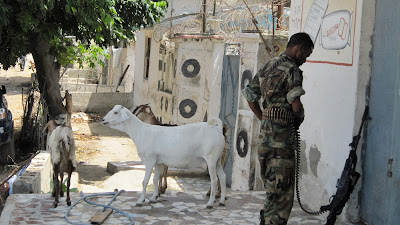
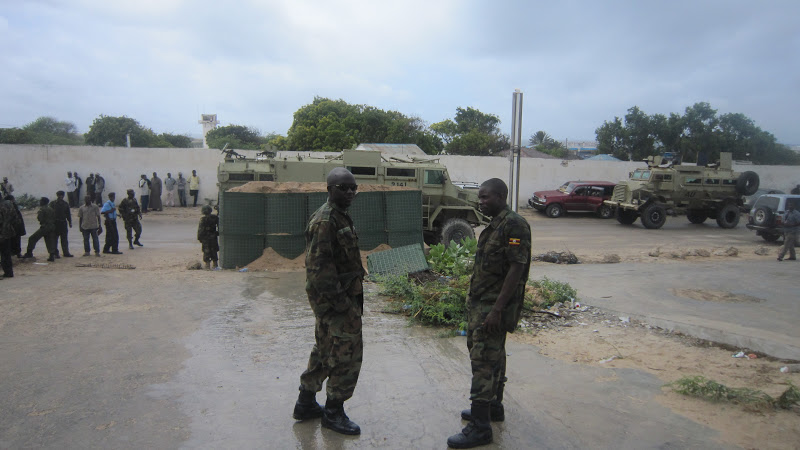
The Somali capital Mogadishu is full of armed men. Some are African Union troops (mainly Ugandan and Burundian), some are government security forces, some are Turkish military, some look like Westerners (usually around the airport area - they do not wear uniforms), some appear to be private militias or bodyguards, and some are simply civilians with guns slung over their shoulders (who told me they would be mad to give up their weapons because they don't trust any of the 'official' security forces such as the AU troops or government soldiers). Here are some photos I took of people with weapons:


AMISOM patrols the streets
Ugandan AMISOM troops
I don't know whether this man was a government soldier, militia man or random armed person
The following photos were taken in one of the many camps for the displaced in the city. It seemed every previously open space in Mogadishu was full of people living in igloo shaped tents patched together from cloth, plastic, cardboard and tin. 


The next lot of photos were taken in Hodan district, Bakara market and other places in Mogadishu.


These photos were taken on a trip to the beach, to the south of Mogadishu:


And this final one was taken in a mosque:


Monday, 8 October 2012

The goats of Mogadishu

On a recent trip to Mogadishu, I noticed that the only living things that seemed to be truly at ease in the city were the goats. The humans were generally nervous and jittery (not surprising given the pops of gunfire, suicide bomb scares, and grenade throwing). The cows looked lost. The donkeys confused - I saw one careering round and round a roundabout, madly circling in the dust.

But the goats seemed to be having a good time. It was if the city belonged to them, as they tripped about the smashed buildings, chewing on leaves, plastic, cloth and paper. Someone told me they have even learned to take cover when required, scampering behind bits of concrete or sandbags when bullets start to fly.


 Most of the goats looked relaxed and well fed
This goat lived in the smashed up old post office in Hodan district, a former stronghold of Al Shabaab
I met these goats relaxing on the steps of the National Theatre, near The Village restaurant which was recently attacked by suicide bombers

These goats were passing the day in Bakara Market, Mogadishu's main commercial district

Siesta on the steps

Friday, 28 September 2012

My US book tour


This photo was taken by Geoff Marsh, The Fletcher School


My US book tour of September and October 2012 took me to four cities. I started off in Boston where The World Peace Foundation at The Fletcher School of Law and Diplomacy at Tufts University invited me to give a talk.

The World Peace Foundation organised my book tour and asked no less than five academics to review my book. I also wrote a response to those reviews. I would like to thank Alex de Waal, Bridget Conley and Lisa Avery of The World Peace Foundation for all their help, as well as the engaged and intelligent students of Tufts University who came to my talks, and asked such interesting and challenging questions.

The book event started with a book-signing in The Hall of Flags at The Fletcher School. 
This photo was taken by Geoff Marsh, The Fletcher School

By chance, the Somali flag was hanging near to where I signed my books
Signing books for students
We then moved to a lecture theatre for the presentation and discussion. I showed some photos from my recent trip to Somalia and Somaliland, some of which I hoped would show that there is more to the 'Somali story' than hunger, war, piracy and Al Qaeda, even though all of those things are also present.

Armed man in Mogadishu
Destroyed parliament in central Mogadishu
Opening of the Coca Cola factory in Somaliland
The Somaliland Circus
You can read a piece about my Tufts talk here: An evening with Mary Harper

I then took the beautiful train journey from Boston to New Haven, whizzing through autumn woodland and past grand properties on the coast, sailboats bobbing in the ocean. My second talk was at Yale University, where I was delighted to see several Somalis in the audience, some of whom had driven in from the town of Hartford, where there is a substantial Somali community. One of them read out a quote from a book called 'Warrior' by Gerald Hanley and asked whether I agreed with it. Here is the quote: "Of all the races in Africa, there cannot be one better to live among than the most difficult, the proudest, the bravest, the vainest, the most merciless, the friendliest: the Somalis'.

Yale


Some Somali members of the Yale audience
It is election season in the US so there are lots of poster, billboards, signs, adverts and endless TV and radio talk about Obama and Romney. I saw this giant anti-Obama billboard...


... in the grounds of this petrol station:


Many people enthusiastically display their political affiliations on their front lawns:


After New Haven, I took the train to Washington DC. Some of the poorer neighbourhoods of some of the towns I passed, especially Baltimore, somehow reminded me of parts of Mogadishu. A group of Somalis met me at the grand Union Station in Washington and looked after me the whole time I was in the city. I spoke at the United States Institute of Peace, which is directly opposite the State Department. 


The United States Institue of Peace is a beautiful building. The roof looks like the wings of a dove.
The event, called Whither Somalia?was so full there had to be an 'overspill room'. The Somali activist, Sadia Ahmed and Deputy Director of the Atlantic Council's Michael S Ansari Africa Centre, Bronwyn Bruton, were on the panel. The chair was Jonathan Temin of the United States Institute of Peace.

Speaking at the United States Institute of Peace
You can watch a video of the event by clicking on this link: Watch the video here

I then headed for New York city where I first spoke at the Centre on Global Counterterrorism Cooperation. This was a closed event. The Somali ambassador to the United Nations was there, as were Kenyan representatives at the UN. The meeting was chaired by Liat Shetret of CGCC.

The next day, Tatiana Carayannis and Ciara Aucoin of the Social Science Research Council organised a marathon day for me. I went to UN headquarters where I held two interesting closed discussions with senior officials working on Somalia. I also spoke at the beautiful, serene Quaker House.

The gardens behind Quaker House, right in the heart of New York city.
This was an open event, attended by different countries' representatives to the UN, NGO officials and friends. The US academic Ken Menkhaus, who has written extensively on Somalia, was the discussant.

Ken Menkhaus and me on the sofa in Quaker House
Good friends came to the event