Friday, 28 September 2012

My US book tour


This photo was taken by Geoff Marsh, The Fletcher School


My US book tour of September and October 2012 took me to four cities. I started off in Boston where The World Peace Foundation at The Fletcher School of Law and Diplomacy at Tufts University invited me to give a talk.

The World Peace Foundation organised my book tour and asked no less than five academics to review my book. I also wrote a response to those reviews. I would like to thank Alex de Waal, Bridget Conley and Lisa Avery of The World Peace Foundation for all their help, as well as the engaged and intelligent students of Tufts University who came to my talks, and asked such interesting and challenging questions.

The book event started with a book-signing in The Hall of Flags at The Fletcher School. 
This photo was taken by Geoff Marsh, The Fletcher School

By chance, the Somali flag was hanging near to where I signed my books
Signing books for students
We then moved to a lecture theatre for the presentation and discussion. I showed some photos from my recent trip to Somalia and Somaliland, some of which I hoped would show that there is more to the 'Somali story' than hunger, war, piracy and Al Qaeda, even though all of those things are also present.

Armed man in Mogadishu
Destroyed parliament in central Mogadishu
Opening of the Coca Cola factory in Somaliland
The Somaliland Circus
You can read a piece about my Tufts talk here: An evening with Mary Harper

I then took the beautiful train journey from Boston to New Haven, whizzing through autumn woodland and past grand properties on the coast, sailboats bobbing in the ocean. My second talk was at Yale University, where I was delighted to see several Somalis in the audience, some of whom had driven in from the town of Hartford, where there is a substantial Somali community. One of them read out a quote from a book called 'Warrior' by Gerald Hanley and asked whether I agreed with it. Here is the quote: "Of all the races in Africa, there cannot be one better to live among than the most difficult, the proudest, the bravest, the vainest, the most merciless, the friendliest: the Somalis'.

Yale


Some Somali members of the Yale audience
It is election season in the US so there are lots of poster, billboards, signs, adverts and endless TV and radio talk about Obama and Romney. I saw this giant anti-Obama billboard...


... in the grounds of this petrol station:


Many people enthusiastically display their political affiliations on their front lawns:


After New Haven, I took the train to Washington DC. Some of the poorer neighbourhoods of some of the towns I passed, especially Baltimore, somehow reminded me of parts of Mogadishu. A group of Somalis met me at the grand Union Station in Washington and looked after me the whole time I was in the city. I spoke at the United States Institute of Peace, which is directly opposite the State Department. 


The United States Institue of Peace is a beautiful building. The roof looks like the wings of a dove.
The event, called Whither Somalia?, was so full there had to be an 'overspill room'. The Somali activist, Sadia Ahmed and Deputy Director of the Atlantic Council's Michael S Ansari Africa Centre, Bronwyn Bruton, were on the panel. The chair was Jonathan Temin of the United States Institute of Peace.

Speaking at the United States Institute of Peace
You can watch a video of the event by clicking on this link: Watch the video here

I then headed for New York city where I first spoke at the Centre on Global Counterterrorism Cooperation. This was a closed event. The Somali ambassador to the United Nations was there, as were Kenyan representatives at the UN. The meeting was chaired by Liat Shetret of CGCC.

The next day, Tatiana Carayannis and Ciara Aucoin of the Social Science Research Council organised a marathon day for me. I went to UN headquarters where I held two interesting closed discussions with senior officials working on Somalia. I also spoke at the beautiful, serene Quaker House.

The gardens behind Quaker House, right in the heart of New York city.
This was an open event, attended by different countries' representatives to the UN, NGO officials and friends. The US academic Ken Menkhaus, who has written extensively on Somalia, was the discussant.

Ken Menkhaus and me on the sofa in Quaker House
Good friends came to the event


Friday, 14 September 2012

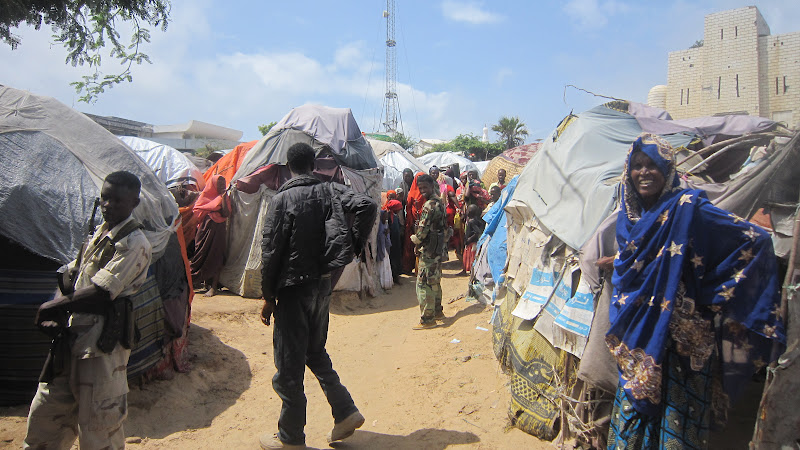
The displaced of Mogadishu

The new president of Somalia, Hassan Sheikh Mohamud, faces a lot of challenges, including the Islamist group Al Shabaab, the Somali regions that have chosen to 'go it alone' and the presence in Somalia of numerous foreign forces. As someone who stayed in Somalia for most of the past two decades of conflict, he will be fully aware of the physical destruction of so much in Somalia and the immense human suffering of so many of its people. I saw that suffering at close hand on a recent trip to Mogadishu, where almost every open patch of land seemed to be inhabited by displaced people living in igloo-shaped structures made from ragged cloth, plastic bags, tin sheets and bits of wire and rope.


A few people in the camps have set up businesses such as this tailor working in a little shop.


This woman told me she had been beaten by guards because she had complained about conditions in the camp
 She had a big bruise on her upper arm


The next three photos show places where people in the camps cook their food.


One camp I visited was different from the rest. It was Jazeera camp beyond the airport in Mogadishu. It is run by the Turkish Red Crescent.


Wednesday, 12 September 2012

Peter Little reviews my book for The Journal of Modern African Studies


This is a review of my book for The Journal of Modern African Studies by the Professor and Chair of Anthropology at the USA's Emory University, Dr Peter D. Little, who wrote the book Somalia: Economy Without State.

Getting Somalia Wrong? Faith, War, and Hope in a Shattered State by MARY HARPER London: Zed Books, in association with International African Institute, Royal African Society, and Social Science Research Council
Mary Harper has done a great service to students and the general public who really want to know what has gone so tragically wrong with Somalia. There now is a readable, well-argued book that one can refer to students and colleagues when peppered with the common question: ‘why is contemporary Somalia such a troubled nation?’ While seasoned experts of Somalia will not find much that is new in the book, they may applaud its accessibility and coverage of so many relevant and timely Somali issues in one single source.
As a seasoned British Broadcasting Company (BBC) journalist who has reported and written about Somalia since the collapse of the state in 1991, Harper nicely counters the plethora of myths about Somalia as a place of anarchy, chaos, and mass jihadists. The book provides enough detail about Somali history, politics, culture, and society, including the importance of clans, to grasp the complexity of Somalia’s current struggles without overly burdening the reader with excessive documentation and references. The author’s ultimate goal is to demonstrate that there were critical junctures in post-1991 Somalia where the international community, especially the US, had a chance to ‘get it right’ with Somalia but, instead, succumbed to poor intelligence and unwarranted fears about terrorism and radical Islam. These poorly-informed assumptions instigated a series of blundering but tragic diplomatic mistakes. For example, by not recognizing the significant opportunity in 2005-2006 to bring the moderate elements of the popular Union of Islamic Courts (UIC) into discussions of political and economic reconstruction in Somalia, the international community ‘got it very wrong’. In 2006 the US threw its support behind a loose collation of warlords called the Restoration of Peace and Counter-Terrorism and later that year provided the green light for a highly unpopular invasion of the country by Somalia’s regional nemesis, Ethiopia. As Harper rightly points out, the goal of these actions was to eliminate an al- Qaeda cell and the UIC, the latter whom were wrongly thought to be strongly connected with global jihadists and terrorism. Instead, the interventions radicalized a large segment of the UIC and fueled the growth of the radical Islamic youth movement, al-Shabaab, which by 2007 controlled most of southern Somalia and forced out most of the UIC’s moderate elements, including the current President of the Western-backed Transitional Federal Government (TFG) of Somalia—Sheikh Sharif Sheikh Ahmed. Harper correctly shows how this misplaced foreign voyeurism contributed to a self-fulfilling prophesy by turning Somalia into a haven for foreign jihadists and al-Qaeda-linked movements, such as al-Shabaab.
Getting Somalia Wrong covers a range of other topics, including Somali piracy, the role of the Somali Diaspora, the stability of the breakway state of Somaliland, the growth of informal financial institutions (hawala), the recent (2011) invasion by Kenya, and the 2011 famine that killed more than 50,000 people. Each of these issues is shown to have different and more nuanced explanations than what is commonly assumed; for example, contra popular accounts Somali piracy is not backed by well-funded, global criminal networks. Moreover, by looking at some of the economic and political successes of Somalia, Harper shows “how Somalis can ‘get it right’ by operating largely on their own initiative and doing things their own way (p. 195).” It is this finding of the book that gives some hope for Somalia’s future as long as it can avoid being an instrument in other country’s agendas.
PETER D. LITTLE
Emory University

Sunday, 26 August 2012

A quiet place in Mogadishu


This is a piece I wrote about the Catholic cathedral in the Somali capital, Mogadishu, for the BBC's From Our Own Correspondent programme which goes out on Radio Four and the World Service. It is also available here on the BBC website. I have added more pictures here so you can see what it is like. 


The atmosphere changed completely when we entered the cathedral. Things fell quiet. It felt almost peaceful.


The nervous, frantic movement of people, animals and vehicles on the streets outside did not follow us. The hysterical beeping of horns fell away, as did the sound of gunfire.
My five Somali bodyguards - wrapped in long, heavy necklaces of brass bullets - did not spring into position around me. They bent their heads towards the smashed floor of the cathedral and walked alongside me.
It was Ramadan in Mogadishu - the holy Muslim month - and we were inside the remains of what had once been one of the grandest Catholic cathedrals in the whole of Africa, built by Italian colonialists in the 1920s. Its last bishop, Salvatore Colombo, was murdered there in 1989 as he was giving mass.
I felt very tiny inside that building. Perhaps because the roof has been completely blown off, the walls of the cathedral seemed to stretch right up to the blue sky above.
Although we were in the carcass of a building, enough remained of the elegant stone arches and the shadows of crosses, for us to know that we were in a sacred place.


As we approached an outline on the floor where the altar used to be, taking care not to step in the human excrement dotted around us, the guards started asking me how the church worked. How Christians worshiped. How exactly did they pray?
The slightly raised area is where the altar used to be
As I explained how the priest administered bread and wine, we looked up. High above us, carved in the stone, was Jesus on the cross. Bullet holes scarred the carving, the colours faded and gone.


It was very different from the streets outside where people, optimistic about the new relative stability, are opening shops, their walls freshly painted with bright images of what is on sale inside.


My guards were especially upset by the statue of St Francis of Assisi, the patron saint of animals. His head had been blown off and the sheep around him were vague shapes of shattered stone.
Livestock is a mainstay of the Somali economy, and very dear to the hearts of Somalis. The guards were unhappy that representations of animals and their saint had been so horribly damaged.
St Francis of Assisi with his head blown off

The Virgin Mary

The Virgin Mary
In one corner was what looked like a pile of discarded cardboard and cloth. Slowly, I made out the figure of a man, so deeply asleep he seemed not to be breathing.


During the rest of my time in Mogadishu, the guards were always hurrying me along. As a foreigner and white woman I stuck out somewhat from the crowds, and they did not want any trouble. I was a potential target, so it was not wise to stay in one place for long.
But things were different in the cathedral. We took our time. All of us seemed hypnotised by the place and found it difficult to leave.
One guard crouched down, lost in thought. Another stood still, gazing upwards past those majestic stone walls to the sky above.

We thoroughly explored the cathedral, every corner, every side room. We glanced down into underground spaces filled with blue plastic bags, rubble and the odd bullet casing.


Suddenly, there was bit of noise and movement. A sound of giggling. Two boys - completely naked - rushed in and emptied plastic jerrycans of water onto their bodies. Scrubbing themselves as best as they could, without any soap.

They then darted into a dark corner, emerging soon afterwards dressed in clothes so old and ragged they appeared to be rotting on their bodies.
Slowly and silently, an old man appeared.
"I fled here with my relatives two years ago. I came from the port of Merca, which was taken by the Islamists, by Al-Shabaab. "I wouldn't have survived under their rule," he told me. "I have no food. I have no water. The only thing I have is time."

He gestured out through one of the arches. Outside, in the grounds of the cathedral were small, tattered igloo-shaped dwellings. Made from bent sticks, and a patchwork of plastic, cloth and cardboard, lashed together with rope, string and quite a lot of hope.


I saw such settlements, of people forced from their homes, on almost every spare patch of ground in Mogadishu. Many Somalis have lived like this for more than two decades.
The cathedral stood in the part of town where the physical devastation was perhaps the most shocking. It is now a graveyard for what had once been the city's most grand and beautiful buildings.
I wonder if, now that things are starting to be fixed up in Mogadishu, it might be an idea to leave that cathedral how it is. As a quiet place. Somewhere for reflection. A reminder of the destruction humans can wreak.