Saturday, 2 May 2015
Saturday, 11 April 2015
Chasing West Africa's Pirates
When Somali piracy was at its height, I did a lot of reporting on the subject for the BBC. I spoke to lots of pirates and got to know people involved in trying to stop the problem, including British naval and other military personnel. They did a pretty good job - piracy dropped significantly in the Indian Ocean and Gulf of Aden. But it increased in West Africa, and some of the people fighting Somali piracy moved to the other side of the continent. They very kindly gave the superb journalist Penny Dale and me wonderful access to what they, the Nigerian navy and others are doing. Here is a link to our documentary:
And here are a couple of BBC Online pieces:
Here is the script of a From Our Own Correspondent I did on the subject:
It may come as a surprise to
hear that Somalia is no longer Africa’s worst piracy hotspot. They may not be
the subject of Hollywood movies or adventure stories, but West African pirates
have overtaken the Somalis, both in terms of the number and the brutality of
their attacks. Mary Harper went to Nigeria to find out more:
Under a busy bridge in Nigeria's
mega-city, Lagos, women in colourful African print sit behind rickety wooden
tables. On the tables are piles of fish, crabs, prawns, lobsters and squid.
Stacked so high that they look like they're about to tumble down into the oily
mud below.
"They come from the deep
water" says the lady with the highest piles of prawns, glistening
creatures in all sizes. Small, medium, large, giant, extra giant, extra extra
giant. "The trawlers bring them in from the high seas."
But Nigeria's fishing industry is
being decimated by piracy and the person best placed to tell me about this is
Margaret Onyema-Orakwusi, the first female head of the Nigerian trawler owners'
association.
On my way to visit her, I sit for some
time in the famous traffic jams of Lagos. Inching along the bridges that swoop
and soar over the lagoons. Tropical rain pounds down from the sky above. Water
seems to be everywhere.
Margaret lives in a large house in a
fancy part of town. There are pictures of ships on her walls, models of boats
in her living room. Even her well-stocked drinks cabinet is shaped like a boat.
"The attacks are deadly and
brutal" she says. "At times the pirates throw the crew into the
ship's cold room where we store the fish. They freeze to death." Margaret
tells me how pirates have planted explosives on her trawlers, shot dead one of
her captains, and fired bullets into the face of her chief engineer.
Unlike most of Nigeria's trawler
owners, who have packed up shop, Margaret is determined to carry on. As is
Rotimi George, a Nigeria seafarer.
He has a sweet smile and a gentle
face. He is dressed smartly in what Nigerians call an 'up and down, top and
trousers in the same colour cloth. His is saffron, his shoes and bag a matching
pale leather.
"I like the freedom of the
sea" Rotimi tells me. "When I'm not on deck, I write. About love,
about God, about myself."
But Rotimi was recently attacked by
pirates. They boarded his ship in the dead of night, shooting open the doors
and taking away the Russian captain and Ukrainian chief officer. They stole Rotimi's
laptop and his phone. They looted the ship, even stealing chicken and other
food from the kitchen.
Rotimi tells me how he and the bosun
hid themselves away, and how awful it was. "I was thinking they might sink
the ship. That would be the worst death, because you would die while hiding. I
would want to see what was killing me."
Unlike many seafarers who are simply too traumatised to
go back to sea after suffering pirate attacks, Rotimi was itching to get back
to work. "Pirates can't stop my dreams" he says, before singing to me
a song about the sea. "I will sail on as far as I can go."
And it’s by sailing out from Lagos harbour that I began
to understand why piracy is such a problem here. The ocean is crammed with
ships at anchor, many waiting to get in to the congested port. Great hulks of
rusting metal, low in the water, almost inviting pirates to sling their ladders
over the side and clamber on board.
I was taken out to sea by Sven Hanson, a man with giant
muscles in his arms. He’s a former member of the British special forces and is
doing very well out of West Africa’s piracy problem. His private security
company works with the Nigerian navy, and he wanted me to see a safe area they
have created in the middle of the ocean.
I found it difficult to absorb the information about the
safe zone, essentially a big circle of sea patrolled constantly by gunboats.
That’s because I was being horribly seasick as Sven described to me how not a
single ship anchored inside this protected area has been attacked or even
approached by pirates.
But West Africa is going to have to do a whole lot more
if it’s going to win the fight against maritime crime. The waters off Nigeria,
Togo and Benin have been declared a ‘War Risk Area’ pushing up the cost of
insurance. This ultimately affects the price of our food, our petrol, anything
that comes by sea from West Africa.
But the highest price of all is being paid by the seafarers.
People like the gentle Rotimi, who the pirates brutalise and kill in their
quest for plunder.
Saturday, 21 March 2015
My Latest Mogadishu Photo Album
Here are some of the photos I took on my latest trip to Mogadishu
| A sunny day in Mogadishu |
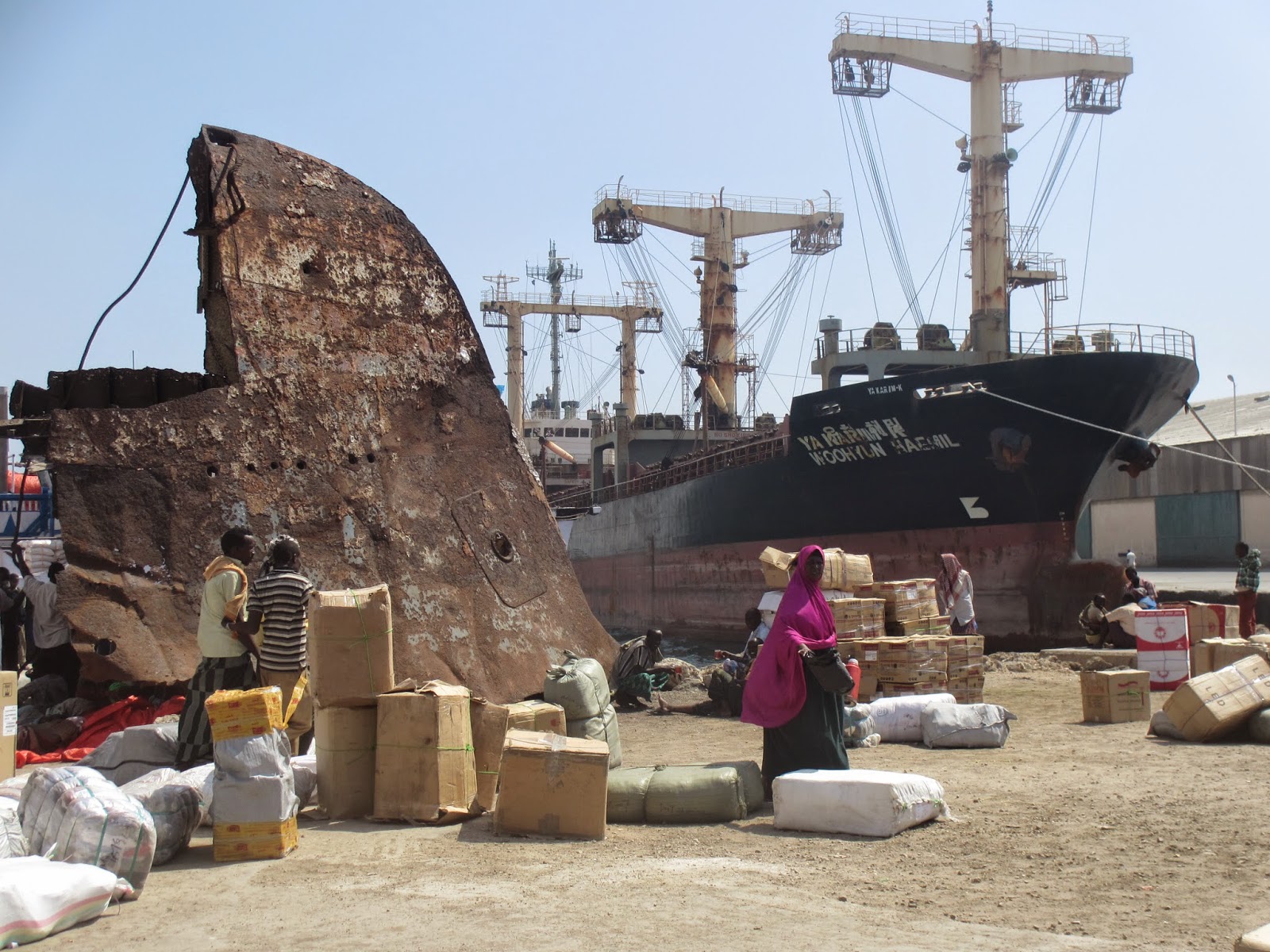
| Mogadishu port is open for business |
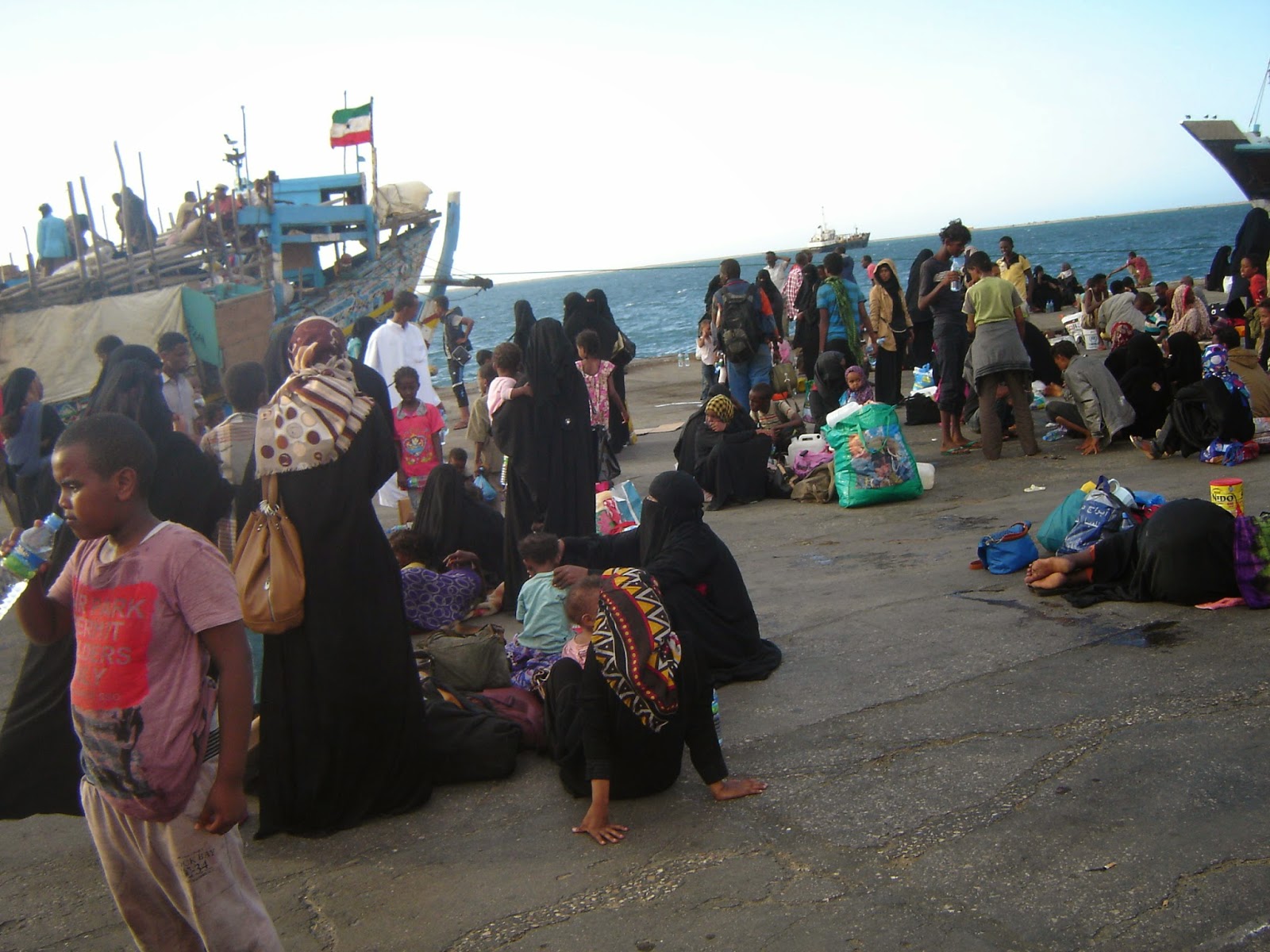
| Dhow - many of the sailors are Gujaratis and Yemenis - many carry goods from Dubai. |
| The port is being run by a Turkish company |
| Mogadishu's first apartment blocks |
| I hope this will one day be my apartment (if I can afford it) |
| My future Mogadishu jacuzzi |
| Pakistanis putting in the lifts for the apartments |
| I got lost in Villa Somalia - home of the government |
| Eventually I found my way to the president's office - these are the 8 Somalia's presidents |
....except during the frequent security alerts and lockdowns...
...which disrupt business and daily life.
If you look carefully you can see the people are wearing face masks..
,,,they are the suicide bomb cleaner-uppers... there was a huge suicide bomb outside the airport... they cleaned up the body parts, vehicle parts and other mess.
I didn't take this photo - a Somali journalist did.. It's of the aftermath of the same suicide blast (apparently the suicide driver was very young). I was told the white people come to the scene of suicide blasts and take bits of 'evidence' away. I don't know what they do with it. And I don't know who those men are - but here are lots of people like them 'behind the wire' at the airport. Some wear NATO uniforms and 'train' people. Others are private contractors.
Saturday, 14 February 2015
The connection between Somalia and Valentine's Day
I was somewhat taken aback when I opened my Facebook page this Valentine's Day morning. I discovered it was the birthday of 30 of my Somali Facebook friends. It reminded me of New Year's Day when 279 of my Somali Facebook friends had their birthdays. True, I have a lot of Somali friends on Facebook - but those numbers are extraordinary. Or maybe not. Many Somalis don't know when their real birthdays are. They have after all lived through more than two decades of war. Records have been destroyed and there is currently no functioning administration. Even before conflict tore their country apart, most Somalis were nomads, and their culture was largely oral. The Somali language wasn't written down until the 1970s. But back to my Facebook page. I wrote a post about the 30 Somali Valentine's birthdays - and all the ones on New Year's Day. Within two hours, the post had more than one-hundred-and-seventy 'likes' and more than fifty comments. Non-Somalis were completely baffled. My Somali friends quickly put them right - in witty and touching ways. Abdi said it was likely only one percent of Somalis who say their birthday is on Valentine's Day were actually born on the 14th of February. Saeed said his father tossed a coin to decide on his birthday. Maxamed was born in a refugee camp. His whole family was, as he put it, 'under such severe depression' that nobody thought about dates of birth. Another friend posted that Somalis should have their birthdays on Doomsday as, he said, 'they are in love with guns and war'. But I would like to say a special thank you to the Somali friend who posted on my Facebook page a photo of a luscious red rose. And to say Happy Birthday to my 30 Somali Valentine's Day friends -- whether or not they were actually born on the 14th of February.
You can listen to my BBC radio report here: The Somali/ Valentine's Day connection
The BBC Somali Service version is here: My report in Somali
Wednesday, 7 January 2015
Gambian government statement on the events of 30 December - code name of President, Sheikh, Professor, Alhaji, Dr Yahya AJJ Jammeh was 'Chuck'
GOVERNMENT STATEMENT ON THE TERRORIST ATTACK
OF 30TH DECEMBER, 2014
On Tuesday, 30th
December, 2014, at 2am GMT, the State House was attacked by a well-equipped, well-funded
group of Gambian terrorists living in the U.S.A., U.K.,
Germany and Senegal with support from their collaborators abroad with
sophisticated automatic machine guns and assault rifles.
Five of these attackers
launched their assault from the main gate of the State House by the Albert
Market while the three others attempted to enter through the rear gate by
Marina Parade.
The leader of the
attackers was Lamin Sanneh (codename ‘Gibia’), a former Lieutenant Colonel of
the Gambia Armed Forces and former Commander of the State Guards Battalion who
was dismissed from the GAF and fled to Senegal and then to the U.S.
He was accompanied
by Njaga Jagne (codename ‘Bandit’), a retired Captain of the US Army; Baboucarr
Lowe, a former Warrant Officer Class 2 of the Gambia Armed Forces referred to
as ‘Bai Lo’ who was wanted in connection with drugs and fled to Senegal and
then to Germany; former Private Modou Njie (codename ‘Mike’) of the Gambia Armed Forces and Private Landing Sonko
(codename ‘Young’), an active member of the Gambia Armed Forces who was on
study leave, was a former orderly of Ex-Lt. Col. Sanneh.
During the
exchange of fire at the main gate, Sanneh and Jagne were killed. Lowe and Sonko
escaped while Modou Njie was captured and is currently helping the intelligence
and security services in their investigations. Glass windows and buildings
pockmarked by bullets can be vividly seen by the gate.
The attackers from
the rear gate included Musa Sarr, Ex-Lance Corporal of the Gambia Armed Forces
(codename ‘Kampama’); retired US Army Sergeant Papa Faal and, Alhagie Nyass, a former
personnel of the defunct Gambia National Gendarmerie and one Dawda Bojang.
Faal
positioned a heavy machine gun by the entrance of the Accidents & Emergency
Unit of the Edward Francis Small Teaching Hospital and repeatedly fired rounds
at the gate. Nyass who attempted to ram his vehicle into the gate was shot dead.
Dawda Bojang who was dressed in military uniform and body armour and positioned
by a heavy machine gun was also killed. Musa Sarr and Papa Faal fled leaving behind
their equipment and military attires.
Other members of
the group were stationed at Brufut Heights, some 25 kilometres from Banjul, the
capital city. They were:
· Cherno
M Njie (codename ‘John’), the main sponsor of the attackers and proposed
Interim Leader. He fled the country after the attack failed.
· Alhagie
Saidy Barrow (codename ‘X’) was the coordinator of the group, responsible for
logistics and clearing of their weapons and other gadgets from the seaport.
· Dawda
Bojang, Ex-Private of Gambia Armed Forces who deserted in 2014.
· Mustapha
Faal is a Gambian resident in Germany. He deserted the group before the attack.
His whereabouts are not known.
According to documents
retrieved from the attackers, this group was to arrest and kill Service Chiefs
and other individuals. The team was awaiting the taking over of the State House
by the attackers and for the proposed leader, Cherno M. Njie to take over the
reins of power. All the four escaped and Cherno M Njie and Papa Faal are facing
legal charges in the United States.
After the
confrontation and the defeat of the attackers by the security forces, a large
quantity of arms was retrieved which included:
· Two (2)
Heavy Machine Guns with telescopic sights
· Seventeen(17)
M&P 15 individual assault
rifles with aiming devices
· Nine
(9) AKM automatic Assault Rifles
· Four
(4) Light Machine Guns
· Three
(3) pistols
· One
(1) Night Vision Goggle, (although
FBI reports that the group had two)
· Eleven sat
Pro Communication devices.
These gadgets
were intended to be used for communication among themselves and to
communicate to the outside world when they have destroyed the communication
infrastructure in the country after failing to capture the State House.
· Seventeen
(17) body armour
· Twenty
(20) webbing jackets
· Five (5)
camel bags.
It is clear from
the documents retrieved from the attackers that this operation was
well-planned. The documents revealed their intention to destroy key infrastructure
including the Central Bank of the Gambia building, Denton Bridge, GAMTEL House
and Kotu Power Station among other national assets.
It was also
discovered that the codename the attackers used to refer to the President of
the Republic of The Gambia was “CHUCK”. This is the same code name that the US
Secret Services used to refer to His Excellency, the President during the last
US-Africa Leaders’ Summit in Washington DC.
While we continue
to assess the situation and developments, the Government of The Gambia under
the leadership of His Excellency, the President, Sheikh Professor Alhaji Dr.
Yahya A.J.J Jammeh assures all citizens, residents and all true friends of The
Gambia near and far, that the security and stability of the Republic of The
Gambia will never be compromised.
The Gambia will
continue to depend only on Allah, the Almighty for the peace, security and
prosperity of our proud and dignified people.
The Government of
The Gambia thanks all those countries that have expressed their genuine goodwill
and solidarity with The Gambia in the wake of this terrorist attack.
Thursday, 1 January 2015
A Circus in the Sand
Books for Peace
One of the most magical weeks of my life
was the one I spent at the Hargeisa International Book Fair in July 2012. Like many
things in Somaliland, I found it delightful, surprising and inspiring, a bit like
opening a box of secret treasures.
I have chosen to write about the book fair
because, in many ways, it represents in microcosm many of the good things about
Somaliland. It also shows how challenges can be overcome because the very idea
of holding such an event in Somaliland requires courage, imagination and
determination.
When I wrote a blog post about the fair, a
journalist from a respected international publication asked if I was joking, if
I had made the whole thing up. For many outsiders, the idea of a book fair on
Somali territory is impossible to imagine because for them the word ‘Somali’ is
associated with piracy, terrorism, war and famine. Somaliland suffers from a
similar image problem; most people don’t know it exists, and have no idea that
it is relatively peaceful, with a functioning economy, society and political
system.
Contributors to this book were asked to
touch on some of twenty themes offered for discussion. They ranged from the
environment to women’s empowerment, from youth employment to heritage and
culture, from the diaspora to diplomacy. As I went through the list, I realised
the Hargeisa International Book Fair embodied almost all of them.
One of my favourite sessions at the fair was
the one entitled ‘The Future of Our Environment’. The environmental campaigner,
Amina-Milgo Mahamud, showed us a film about how chopping down trees for
charcoal is wrecking the Somali environment. There was a speech by the
environmentalist, Ahmed Elmi, who looked quite the part with his enormous white
beard and white cloth hat.
At the fair, I bought a wonderful book,
written in English and Somali, called Environment
in Crisis: Selected Essays with a Focus on the Somali Environment. I read
about the precious resources of Somaliland, including the Zizyphus Tree, whose fruit
makes a nourishing drink and whose leaves are used to make shampoo and face
masks. The chapter started with a Somali proverb:
There
is a big Zizyphus tree on the surface of the moon with leaves matching, at any
given point of time, with the number of living people on the planet. When a
baby is born, the tree brings forth a new leaf and when a person dies, his or
her leaf withers away and falls from the tree.
I also read a chapter called ‘Me and My
Toothbrush Tree’ about the Caday tree whose twigs are used to clean the teeth
and freshen the breath. The next chapter was about Maydh Island, situated off
the coast of Somaliland, which is rich in birdlife. I learned about the Dragon’s
Blood Tree, which is so resilient that it can even grow out of vertical cliff
faces. It gets its name from its red resin, which is used as lipstick, medicine
and, to this day, as a varnish for violins.
The theme of ‘women’s empowerment’ was much
in evidence as the book fair gave women more public space than they usually
have in Somali society. Many of the presentations were by women, and several of
the most intelligent questions and comments came from young women in the
audience, who are often marginalised in Somali public life. Women also played a
major role in activities taking place outside the main hall, selling books,
refreshments, Somali handicrafts and clothes.
The Somali youth also had their day in the
sun. Enthusiastic young members of book clubs from all over Somaliland were
given the stage, as were young singers, dancers and actors. The Hargeisa
International Book Fair was far more than just a book fair – there was also poetry,
music, song, dance, theatre and more.
There was such enthusiasm for the fair
that, from day one, there were far too many people to fit inside the large hall
where the presentations were held. The organisers showed a typically Somali innovative
spirit, technological know-how and ability to think on their feet by
immediately setting up large screens outside the hall so people could see and
hear what was going on inside.
The fact that so many young people came to
the book fair revealed not only a thirst for knowledge, but also highlighted the
lack of activity and entertainment for the youth of Somaliland. Being young and
having nothing to do can be a dangerous combination. Just a few hundred
kilometres to the south Hargeisa, many young Somalis were finding distraction
by taking up arms and joining the various militia groups tearing apart Somalia.
I found myself thinking of this as I
watched boys, dressed in animal print costumes, sailing through the air, forming
giant human pyramids and throwing fire. They were members of the Somaliland
Circus, which performed on the last day of the fair. They were the same age as
those being forcibly recruited into the Islamist Al Shabaab movement and other
armed groups, across the borders in Somalia.
The book fair, which by 2012 was in its
fifth year, is the brainchild of the publisher, mathematician, computer analyst
and inventor, Jama Musse Jama, who is based in Italy. As well as trying to
revive Somali cultural life, much of which was destroyed by the long years of
conflict, Jama says he also started the book fair for the youth:
“At the end of the day, I did it for
young Somalis. Literature and culture give young people a wonderful way of
growing up, and allow them to make their minds up for themselves. The book fair
offers the Somali youth an alternative to guns; it gives them a platform to
come together and express themselves. It helps fills the vacuum left behind after
the war.”
Like so much in Somaliland, the book fair
only works because of volunteers, from those who give their time to plan and
organise the events, to the contributors who fly in from abroad. Young Somali
volunteers ran the book stalls with great professionalism, writing out a neat
receipt for every purchase. I ended up with many such receipts, as I could not
resist the books on sale. Among my purchases were a trilingual Physics book, in
Somali, English and Arabic, Somali translations of Anton Chekhov’s short stories
and George Orwell’s Animal Farm, and a book called ‘Somalis do not Lie in
Proverbs’, which was launched at the fair by the Russian Somali expert, Georgi
Kapchits.
The Somali diaspora plays a prominent role
in the book fair. Many of the organisers are based in Europe, and several of
the speakers came from abroad, including the London-based author, Nadifa
Mohamed, and the famous Somali poet, Said Salah, who is based in Minneapolis.
Much has been written about how the
diaspora helps Somaliland economically, mainly through remittances. But the
involvement of the diaspora in the book fair adds another dimension, showing
how the global Somali community can enhance cultural life in Somaliland.
However, the diaspora can also play a negative role by meddling destructively
in politics from abroad, or running irresponsible media operations.
‘Those who stayed behind’ sometimes feel
resentful towards members of the Somaliland diaspora who jet in from overseas
to take up political posts or flash their money around during the summer
holidays. But such feelings were not much in evidence at the book fair, when
both ‘sides’ seemed to bring out the best in each other. As one of the main
organisers of the fair, London-based Ayan Mahamoud, explains:
“The
diaspora has both something to give to and something to learn from the book
fair and Somaliland in general. We members of the diaspora should be humble
enough to learn from those who have worked harder than us and have done the
legwork. We are there to give people a platform to determine their own future,
to bring together youth groups, women activists and members of the diaspora,
who usually work in isolation from each other. The book fair brings together
youth from different regions of Somaliland so they can learn from each other.”
The passionate engagement of the diaspora
in the fair and other activities, and the amount of time it spends in
Somaliland, suggests the word ‘diaspora’ is in some ways misleading in the
Somali case, as so many people have a foot permanently in both worlds.
The book fair plays a significant
diplomatic role for Somaliland. Jama Musse Jama says it is a good advertisement
for the territory because it “shows that Somaliland exits and that Somaliland
is cool”. The 2012 fair was treated to a surprise visit by the British
ambassador to Somalia, Matt Baugh, and other senior European diplomats. Mr
Baugh could not hide his delight as he listened to the presentations and wandered
around the stalls. Security was discreet, a sharp contrast to the armoured
vehicles and heavily-armed bodyguards he is used to in Mogadishu. The
ambassador’s smile turned to slight embarrassment when he was presented with a
huge Somaliland flag; Britain, like all other countries in the world, does not
recognise Somaliland as an independent nation.
It was not only foreign diplomats who came
to the fair. Other foreigners also took part, including an editor from Penguin
Books, Helen Conford and the Korean-Brazilian film-maker, Iara Lee.
Helen Conford:
“When I arrived in Somaliland it didn't feel
much like London (beside the
numerous English accents on the plane) but the
Hargeisa Book Fair feltjust like the best Book Fairs and Literary
Festivals I've attended. Iwas struck by the range of publishing and the palpable
energy aroundculture; the mix of events and live
performances, authors and debate. Itwas very professional - in the best sense of the
word - and exhilaratingto be a part of.”
For the jazz clarinetist from New Orleans,
Evan Christopher, who played with the ‘King of the Somali lute’, Hudaydi, his
trip to Somaliland was the first he had ever made to Africa:
“In
America, most people don’t know what Somaliland is, let alone where it is. The
country is much greener than I expected. I thought it would be a desert! I
didn’t expect to find so many similarities between the culture of Somaliland
and the culture of New Orleans. It’s strange but both locales are dealing with
a large exodus after, in our case, the devastating flooding or our city, and, in
the case of Somaliland, of war. But, remarkably, in terms of the role of
culture in the rebuilding process, I have found a lot of similarities.
The book fair has led to constructive
dialogue and idea-sharing between Somaliland and Somalia, despite the often
tense and unresolved relations between the two territories. The director of the
Mogadishu-based Heritage Institute for Policy Studies, Abdi Aynte, has been to
the Hargeisa book fair twice, and was so inspired that he wants to try out the same
thing in Mogadishu:
“The
message I got from the events was that of peace, prosperity and civility. As I
returned to my native city of Mogadishu after almost 20 years in the diaspora
to start a think tank, I thought that a book fair would restore the cultural
prowess of the Somali capital, and would promote a culture of learning and
inquiry. More importantly, the book fair would contribute to the peacebuilding
efforts, and would create a platform for civil discourse and engagement.”
As the title of this book suggests,
Somaliland is at a crossroads. With so much international attention, time, manpower
and money being focused on Mogadishu and other parts of southern and central
Somalia, the issue of Somaliland risks being pushed into the backs of people’s
minds.
There does not seem to be much room for
manoeuvre in terms of its status. The new president of Somalia, Hassan Sheikh
Mohamud, has said unequivocally that he believes in the unity of Somalia, and
that this includes Somaliland. Somaliland, however, says its independence is
non-negotiable.
Somaliland is under increased risk from Al
Shabaab, which has moved northwards after withdrawing from many of its southern
strongholds in Somalia. In January 2013, Britain urged British citizens to
leave Somaliland, warning of a ‘specific threat’ against Westerners. The
warning has already had an impact, with some Westerners leaving Somaliland or
cancelling planned visits to the territory. Even if the ‘specific threat’ never
materialises, the warning in itself has done significant damage to Somaliland’s
reputation, which has for many years been considered to be the safest part of
Somali territory.
Somaliland is also at a crossroads in terms
of its domestic politics. The government in 2012 took the bold step of further
opening up the democratic space by allowing more political parties to compete
in local elections, with the winning three allowed to contest national polls.
This resulted in a clan-related violence and a number of deaths, showing the
vulnerability of the political situation.
Somaliland is facing a new set of
challenges, but it has faced numerous obstacles before. The theme of the 2013 book
fair is ‘The Journey’, and Somaliland’s journey over the next few years is
likely to be difficult, but not impossible. The book fair shows how much people
can achieve with a little money and a lot of passion, imagination and
commitment. In this way, it resembles Somaliland, which in a space of just 20
years has built itself up from the rubble of war into a functioning polity. It
also shows what a crucial role art, literature and culture play in society, not
just as a form of entertainment, but in the case of Somaliland, offering an
alternative vision and choice to violence.
Thursday, 20 November 2014
Subscribe to:
Posts (Atom)