Wednesday, 11 July 2012

The flight to Mogadishu


"The flight to Mogadishu is full. You will have to catch the next one, which leaves at nine o'clock." 


"Not possible," I told the man at the check in desk at the airport in Nairobi. "I have a ticket for this flight and I have arrived in plenty of time." 


It was shortly after five in the morning, and the plane was due to leave at seven. I eventually managed to convince the man to squeeze me on. My friend who also had a ticket and had arrived before me was not so lucky.


The plane was, as promised, completely full. Most of the passengers were Somali families, many of them from the diaspora. Some told me they were going on holiday, others to resettle permanently.


I sat next to a shopkeeper from Bristol and his teenaged nephew. "Two friends on my street  have been on holiday to Mogadishu. There was no way I could wait any longer. I fled the city in 1998. Today is my first time back. I have been trying to get a flight for the past three days. Every one of the four flights a day to Mogadishu from Nairobi has been fully booked. It's even worse with the Dubai - Mogadishu flights. " 


The holiday began in the waiting room. Children rushed about, a father held a sleeping baby in his arms, women chatted and giggled. There was an even more excitable atmosphere on the plane, which became fever-pitched as we started our descent. 


A large group of women at the back of the plane got our their make up. Large plastic palettes of brightly coloured eyeshadow, glossy lipstick applied to smiling mouths, eyebrows pencilled in with black kohl. It was like they were preparing for a party.


As we swept in over the coast, people on the left hand side of the plane got out their cameras. I passed mine to a slim young woman in a mustard coloured headscarf.


People remarked on the shiny new roofs on the buildings. From a height, Mogadishu looked little different from many other African cities, low-rise buildings spread out from each other, separated by vegetation. Near the beach, however, were what looked like car parks full of military vehicles and row upon row of white tents.


The plane glided down along the seashore. It must be one of the most beautiful landings on earth; the sparkling turquoise waves crash onto the sand a few metres away from the window. I felt I could reach out and touch the sea.


The young people on board babbled excitedly about how they couldn't wait to go to the beach. The mood of my neighbour, the man from Bristol, swung from talkative delight to quiet thoughtfulness. He was about to see relatives and his family home for the first time in 14 years. 


The airport was busier and more organised than the last time I visited in January 2011. As you can see from the photo below, the strong Turkish presence in Mogadishu was in evidence as soon as we taxied towards the terminal. Its flag was painted on concrete bollards - the blue Somali flag on others.


I said goodbye to my neighbours and gave them a copy of my book.


People stood up before the plane came to a standstill. They couldn't wait to get out, touch Somali soil and start their holidays.


Aden Adde international airport in July 2012


The airport has had a facelift since the old days but the basic structure remains.


The arrival hall was neat and fairly orderly. People had to fill in yellow immigration forms before completing the formalities, collecting their bags, greeting their relatives and going home.


Sunday, 8 July 2012

Somalis in Dubai


Here is a report I did for the BBC about Somalis in Dubai. There are tens of thousands of Somalis in the United Arab Emirates. Many work as traders in the souks and at the port. It is said that Somalia exports more from Dubai than any other country apart from Iran. My guide was a Somali called Adan. As you can hear from my report, we started off in the souk:


My BBC radio report on the Somalis in Dubai

Photos of the souk:


The bright Somali women's outfits I mentioned in the report
Entrance to a mainly Somali gold souk


Here are some photos of the Somali port, which stretches along the creek running through Dubai:

Tiles bound for the port of Berbera in Somaliland

Tyres waiting to be loaded onto a dhow. The crew of the dhows are mainly Gujeratis from India. They told me they had no fear of pirates or of sailing into Mogadishu and other Somali ports.

The Somali clothes traders I met at the port. They said business was good.

A lot of paint was on its way to Somalia

Migrant workers on their way home across the creek


Sunday, 1 July 2012

Africa Writes

The inaugural African literature festival, Africa Writes, was held on the weekend of 30 June-1 July 2012. It was organised by the Royal African Service for two main reasons. To celebrate new writing from Africa and to mark the fiftieth anniversary of the famous Heinemann African Writers Series that brought the works of so many African writers and leaders to the wider world. Authors like Chinua Achebe, Ngugi wa Thiongo and Buchi Emecheta. Leaders like Nelson Mandela, Kwame Nkrumah and Kenneth Kaunda.

You can read more about the festival here: Africa Writes

I was lucky enough to be invited to a dinner for the authors attending Africa Writes, some to launch new books, others to talk about their work. It was held in the British Museum, close to closing time.


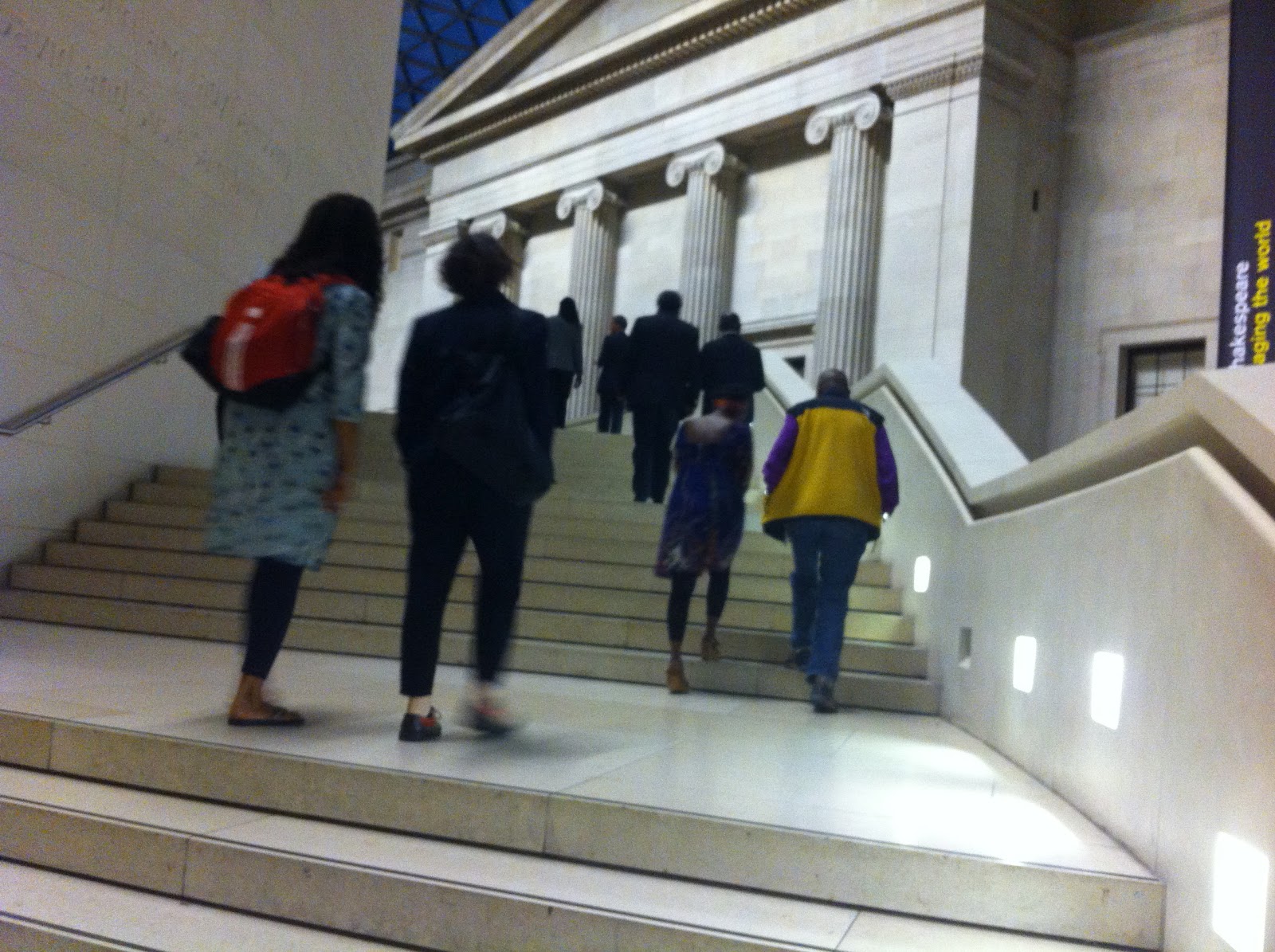
After dinner in the Great Court we were given a magical treat. The museum had closed by then, and as night began to fall, we were taken by the curator Chris Spring on a private tour of the Africa Galleries. He held us spellbound, bringing objects to life with his knowledge and passion.

Pot by the Kenyan ceramicist Magdalene Odundo

Africa curator Chris Spring

Tree of Life made from weapons used in Mozambique's civil war

Director of the British Museum, Neil MacGregor

Sheila Ruiz of the Royal African Society


Chris Spring in full swing


The Somali author, Nuruddin Farah who was launching his new novel Crossbones
 After the tour we went back to the restaurant to have pudding and coffee, and to listen to the kora. By then, darkness had fallen completely and we had the museum to ourselves.


Africa Writes began the next day with a feast of talks, book launches, poetry readings and storytelling for children. 

Scupltures by the Nigerian artist Sokari Douglas Camp at the entrance to the festival

Books for sale including How Shall we Kill the Bishop? which was launched by the Kenyan writer Lily Mabura

Lily Mabura and me

Zed Books had a stall at the fair. It was (wo)manned by Anneberth Lux. My book on Somalia was on sale. It is third from the left on the bottom row in the photo below - the one with the blue cover with a white star. 


There was delicious African food for sale
The Nigerian author, Chimamanda Ngozi Adichie, gave the Africa Writes Lecture

In the evening Granta Books hosted a dinner for the Somali writer, Nuruddin Farah.

Deputy Editor of Granta magazine Ellah Allfrey and South African musician Hugh Masekela

Nuruddin Farah and the Somali author of Black Mamba Boy, Nadifa Mohamed

Nuruddin, Nadifa and me
Hugh Masekela, Scottish journalist Isabel Hilton and Nuruddin Farah

Sunday, 24 June 2012

Review of my book in African Affairs


African Affairs, published June 12, 2012
African Affairs, 00/00, 1–2 © The Author 2012. Published by Oxford University Press on behalf of Royal African Society. All rights reserved
BOOK REVIEW
Getting Somalia Wrong? Faith, war and hope in a shattered state, by Mary Harper. London and New York, NY: Zed Books, 2012. 232 pp. £12.99 (paperback). ISBN 978 1 84277 933 0.
Mary Harper’s book is a very timely account of the major aspects of the protracted Somali crisis. In six chapters plus Introduction and Conclusion, Harper puts across one main argument: Somalia is not entirely failed. There are many aspects of the Somali situation that merit our attention and can be described as hopeful, positive developments. A lot can be learned from ‘the Somali way of doing things’ (p. 2). This contrasts strongly with the negative perspectives on everything Somali that dominate current international politics and popular percep- tions. In fact, the word ‘Somalia’ has become a synonym for war, anarchy, terror- ism, piracy, and humanitarian disaster, and the country serves as a warning to all others not to go down the road of complete state collapse.
Chapter 1 on clan and country, and Chapter 2 on history aim to provide the necessary background for readers unfamiliar with Somali affairs. While they go a considerable way toward doing that, these are the book’s weakest chapters. They contain several factual errors or mistranslations of Somali names. For instance, the assumption of a north–south migration of Somalis (p. 45) contradicts the established literature on that subject, and the chapters perpetuate a stereotypical picture of ‘the Somali’ as a ‘nomadic’ and ‘warlike’ people (pp. 23, 45, for example).
Harper is best when she describes events that she herself witnessed or covered in her long career as a BBC journalist involved with Somalia since the fall of the government of Mohamed Siyad Barre in 1991. Her outline of the start of the civil war in Mogadishu (pp. 56–9) is arresting and intense. It is Harper’s great skill to combine her descriptive and analytical account with quotes and anecdotes from Somali actors, be they refugees, businessmen, pirates, Islamists, or colleagues. These strengths come to the fore in chapters 3–5 on Islamism, state failure (with a question mark), and piracy. These chapters provide extremely readable, up-to-date and well-researched introductions to these topics that together account for the stereotypical and, as Harper rightly argues, wrong representation of Somalia and Somalis. There are many things that actually work in Somalia. Some parts of the economy have grown incredibly during the periods of statelessness. The telecom- munications sector and the informal banking systems are symbols of Somali entre- preneurial spirit and ingenuity. Peaceful and increasingly democratic polities such as Somaliland and (to a lesser degree) Puntland show that bottom-up state- building ‘Somali style’ is possible. Nonetheless, the negative representations of Somalia perpetuated by the international media are often taken as the starting point for formulating and justifying misguided policies toward Somalia. Harper underlines repeatedly, and most strongly at the beginning of Chapter 6 on Somalia and the outside world, that such wrong perceptions and policies have dramatically backfired over the past two decades. The most costly and damaging episodes of external intervention were the paranoid treatment of the Union of Islamic Courts (UIC) as Taliban-like terrorists, and the subsequent Ethiopian military intervention backed and partly aided by the USA. Each intervention (beginning with the ‘humanitarian’ mission of 1992–5) has not only damaged the credibility of the international community, and cost large sums of money, but also claimed the lives of thousands of innocent Somalis and brought great suffering to the survivors.
It is a minor weakness that the author’s commitment to getting Somalia and Somalis right sometimes leads her to overlook details such as the outrageously self-destructive politics and ‘diplomacy’ of the UIC leadership. It was a clear mistake for the courts to openly ‘flirt’ with Eritrea, to declare jihad against Ethiopia and the West, and to invite fellow jihadists to Somalia knowing that these actions would provoke a strong reaction by its powerful neighbour and Western powers. Harper’s account of Somaliland as the most accomplished and democratic Somali polity is correct only in so far as it refers to the central and western regions of this de facto state. Other parts of the country, notably the eastern regions, are not as stable as they seem. Finally, one should not forget that, despite the impres- sive success stories that Harper narrates, many ordinary Somalis still live in extreme poverty. In particular, youths and single mothers are often faced with tough decisions for survival.
Harper’s point about the tendency of external spectators and politicians to mistreat Somalia and Somalis was proven again most recently, when leaders from more than 50 countries and some Somali politicians with doubtful reputations back home met in London in February 2012 to decide Somalia’s fate without con- sidering the true potential and wishes of the Somali people.
Getting Somalia Wrong? is engaged, very well written, and provides deep insights into Somali affairs in only 200 pages, something most academics could not ac- complish. The book is, therefore, despite the flaws mentioned above, the best con- temporary introduction to Somali politics and humanitarian issues on the market. It should be read by undergraduate students of any subject related to Africa, as well as by aid workers and politicians concerned with Somalia or similarly complex crisis states.
Max Planck Institute for Social Anthropology MARKUS VIRGIL HOEHNE doi: 10.1093/afraf/ads043

Thursday, 21 June 2012

Somalia and Somaliland


Here is the communique from the first formal direct talks between Somalia and Somaliland since Somaliland declared itself independent more than twenty years ago. The talks were facilitated by the UK, EU and Norway. They were held in a very posh place called Chevening House in the county of Kent in south-east England. It is the official residence of the deputy prime minister Nick Clegg and the foreign secretary William Hague. 


Chevening House

The two sides have called on their respective presidents to meet as soon as possible. 


President Sheikh Sharif Sheikh Ahmed of Somalia

President Ahmed Silanyo of Somaliland


Chevening House Declaration following talks between Somali Transitional Federal Government and Somaliland

1. Following the commitments in the London and Istanbul communiqués that the international community would support dialogue between the
Transitional Federal Government of Somalia (or its replacement) and Somaliland to clarify their future relations, the two sides met at a technical
level on 20‐21 June at Chevening.

2. The meeting was hosted by the UK and co‐hosted by Norway and EU, at the request of the two sides.

3. The purpose of these preparatory talks was to establish a framework for future substantive talks.

4. The participants of the meeting welcomed the opening of a dialogue and emphasised their commitment to the continuation of these talks.

5. The participants:
(i) Agreed that the talks would take place between two sides ‐ the TFG (or its replacement) and Somaliland, in accordance with paragraph 6
of the London Conference Communiqué and paragraph 10 of the Istanbul II Conference Communiqué;

(ii) Noted the need to adopt a common approach to avoid anything that would undermine the continuation of the talks as defined above;

(iii) Committed to the continuation of the talks and called on the two presidents to meet to review progress as soon as possible;

(iv) Called on the international community to continue to facilitate the talks, including providing the two sides with external experts on legal,
economic and security matters;

(v) Agreed to share experience on working more effectively with the international community on the use of development and humanitarian assistance for the people of both sides and called for the international community to increase that assistance;

(vi) Agreed to cooperate in the fight against terrorism, extremism and serious crime;

(vii) Agreed to cooperate in the fight against piracy at sea and on land, maritime crime, illegal fishing and toxic dumping; and

(viii) Reiterated their support for ending the Transition in Somalia.

Tuesday, 19 June 2012

Nobel Lecture by Aung San Suu Kyi


Nobel Lecture by Aung San Suu Kyi, Oslo, 16 June, 2012

Your Majesties, Your Royal Highness, Excellencies, Distinguished
members of the Norwegian Nobel Committee, Dear Friends,

Long years ago, sometimes it seems many lives ago, I was at Oxford
listening to the radio programme Desert Island Discs with my young son Alexander. It was a well-known programme (for all I know it still continues) on which famous people from all walks of life were invited to talk about the eight discs, the one book beside the bible and the complete works of Shakespeare, and the one luxury item they would wish to have with them were they to be marooned on a desert island. At the end of the programme, which we had both enjoyed, Alexander asked me if I thought I might ever be invited to speak on Desert Island Discs. “Why not?” I responded lightly. Since he knew that in general only celebrities took part in the programme he proceeded to ask, with genuine interest, for what reason I thought I might be invited. I considered this for a moment and then answered: “Perhaps because I’d have won the Nobel Prize for literature,” and we both laughed. The prospect seemed pleasant but hardly probable.

(I cannot now remember why I gave that answer, perhaps because I had recently read a book by a Nobel Laureate or perhaps because the Desert Island celebrity of that day had been a famous writer.)

In 1989, when my late husband Michael Aris came to see me during my first term of house arrest, he told me that a friend, John Finnis, had nominated me for the Nobel Peace Prize. This time also I laughed. For an instant Michael looked amazed, then he realized why I was amused.
 
The Nobel Peace Prize? A pleasant prospect, but quite improbable!
                    So how did I feel when I was actually awarded the Nobel Prize for Peace? The                 question has been put to me many times and this is surely the most
appropriate occasion on which to examine what the Nobel Prize means to
me and what peace means to me.

As I have said repeatedly in many an interview, I heard the news that
I had been awarded the Nobel Peace Prize on the radio one evening. It
did not altogether come as a surprise because I had been mentioned as
one of the frontrunners for the prize in a number of broadcasts during
the previous week. While drafting this lecture, I have tried very hard
to remember what my immediate reaction to the announcement of the
award had been. I think, I can no longer be sure, it was something
like: “Oh, so they’ve decided to give it to me.” It did not seem quite
real because in a sense I did not feel myself to be quite real at that
time.

Often during my days of house arrest it felt as though I were no
longer a part of the real world. There was the house which was my
world, there was the world of others who also were not free but who
were together in prison as a community, and there was the world of the
free; each was a different planet pursuing its own separate course in
an indifferent universe. What the Nobel Peace Prize did was to draw me
once again into the world of other human beings outside the isolated
area in which I lived, to restore a sense of reality to me. This did
not happen instantly, of course, but as the days and months went by
and news of reactions to the award came over the airwaves, I began to
understand the significance of the Nobel Prize. It had made me real
once again; it had drawn me back into the wider human community. And
what was more important, the Nobel Prize had drawn the attention of
the world to the struggle for democracy and human rights in Burma. We
were not going to be forgotten.

To be forgotten. The French say that to part is to die a little. To be
forgotten too is to die a little. It is to lose some of the links that
anchor us to the rest of humanity. When I met Burmese migrant workers
and refugees during my recent visit to Thailand, many cried out:
“Don’t forget us!” They meant: “don’t forget our plight, don’t forget
to do what you can to help us, don’t forget we also belong to your
world.” When the Nobel Committee awarded the Peace Prize to me they
were recognizing that the oppressed and the isolated in Burma were
also a part of the world, they were recognizing the oneness of
humanity. So for me receiving the Nobel Peace Prize means personally
extending my concerns for democracy and human rights beyond national
borders. The Nobel Peace Prize opened up a door in my heart.

The Burmese concept of peace can be explained as the happiness arising
from the cessation of factors that militate against the harmonious and
the wholesome. The word nyein-chan translates literally as the
beneficial coolness that comes when a fire is extinguished. Fires of
suffering and strife are raging around the world. In my own country,
hostilities have not ceased in the far north; to the west, communal
violence resulting in arson and murder were taking place just several
days before I started out on the journey that has brought me here
today. News of atrocities in other reaches of the earth abound.
Reports of hunger, disease, displacement, joblessness, poverty,
injustice, discrimination, prejudice, bigotry; these are our daily
fare. Everywhere there are negative forces eating away at the
foundations of peace. Everywhere can be found thoughtless dissipation
of material and human resources that are necessary for the
conservation of harmony and happiness in our world.

The First World War represented a terrifying waste of youth and
potential, a cruel squandering of the positive forces of our planet.
The poetry of that era has a special significance for me because I
first read it at a time when I was the same age as many of those young
men who had to face the prospect of withering before they had barely
blossomed. A young American fighting with the French Foreign Legion
wrote before he was killed in action in 1916 that he would meet his
death:  “at some disputed barricade;” “on some scarred slope of
battered hill;” “at midnight in some flaming town.” Youth and love and
life perishing forever in senseless attempts to capture nameless,
unremembered places. And for what? Nearly a century on, we have yet to
find a satisfactory answer.

Are we not still guilty, if to a less violent degree, of recklessness,
of improvidence with regard to our future and our humanity? War is not
the only arena where peace is done to death. Wherever suffering is
ignored, there will be the seeds of conflict, for suffering degrades
and embitters and enrages.

A positive aspect of living in isolation was that I had ample time in
which to ruminate over the meaning of words and precepts that I had
known and accepted all my life. As a Buddhist, I had heard about
dukha, generally translated as suffering, since I was a small child.
Almost on a daily basis elderly, and sometimes not so elderly, people
around me would murmur “dukha, dukha” when they suffered from aches
and pains or when they met with some small, annoying mishaps. However,
it was only during my years of house arrest that I got around to
investigating the nature of the six great dukha. These are: to be
conceived, to age, to sicken, to die, to be parted from those one
loves, to be forced to live in propinquity with those one does not
love. I examined each of the six great sufferings, not in a religious
context but in the context of our ordinary, everyday lives. If
suffering were an unavoidable part of our existence, we should try to
alleviate it as far as possible in practical, earthly ways. I mulled
over the effectiveness of ante- and post-natal programmes and mother
and childcare; of adequate facilities for the aging population; of
comprehensive health services; of compassionate nursing and hospices.
I was particularly intrigued by the last two kinds of suffering: to be
parted from those one loves and to be forced to live in propinquity
with those one does not love. What experiences might our Lord Buddha
have undergone in his own life that he had included these two states
among the great sufferings? I thought of prisoners and refugees, of
migrant workers and victims of human trafficking, of that great mass
of the uprooted of the earth who have been torn away from their homes,
parted from families and friends, forced to live out their lives among
strangers who are not always welcoming.

We are fortunate to be living in an age when social welfare and
humanitarian assistance are recognized not only as desirable but
necessary. I am fortunate to be living in an age when the fate of
prisoners of conscience anywhere has become the concern of peoples
everywhere, an age when democracy and human rights are widely, even if
not universally, accepted as the birthright of all. How often during
my years under house arrest have I drawn strength from my favourite
passages in the preamble to the Universal Declaration of Human Rights:

……. disregard and contempt for human rights have resulted in barbarous
acts which have outraged the conscience of mankind, and the advent of
a world in which human beings shall enjoy freedom of speech and belief
and freedom from fear and want has been proclaimed as the highest
aspirations of the common people,

…… it is essential, if man is not to be compelled to have recourse, as
a last resort, to rebellion against tyranny and oppression, that human
rights should be protected by the rule of law . . .

If I am asked why I am fighting for human rights in Burma the above
passages will provide the answer. If I am asked why I am fighting for
democracy in Burma, it is because I believe that democratic
institutions and practices are necessary for the guarantee of human
rights.

Over the past year there have been signs that the endeavours of those
who believe in democracy and human rights are beginning to bear fruit
in Burma. There have been changes in a positive direction; steps
towards democratization have been taken. If I advocate cautious
optimism it is not because I do not have faith in the future but
because I do not want to encourage blind faith. Without faith in the
future, without the conviction that democratic values and fundamental
human rights are not only necessary but possible for our society, our
movement could not have been sustained throughout the destroying
years. Some of our warriors fell at their post, some deserted us, but
a dedicated core remained strong and committed. At times when I think
of the years that have passed, I am amazed that so many remained
staunch under the most trying circumstances. Their faith in our cause
is not blind; it is based on a clear-eyed assessment of their own
powers of endurance and a profound respect for the aspirations of our
people.

It is because of recent changes in my country that I am with you
today; and these changes have come about because of you and other
lovers of freedom and justice who contributed towards a global
awareness of our situation. Before continuing to speak of my country,
may I speak out for our prisoners of conscience. There still remain
such prisoners in Burma. It is to be feared that because the best
known detainees have been released, the remainder, the unknown ones,
will be forgotten. I am standing here because I was once a prisoner of
conscience. As you look at me and listen to me, please remember the
often repeated truth that one prisoner of conscience is one too many.
Those who have not yet been freed, those who have not yet been given
access to the benefits of justice in my country number much more than
one. Please remember them and do whatever is possible to effect their
earliest, unconditional release.

Burma is a country of many ethnic nationalities and faith in its
future can be founded only on a true spirit of union. Since we
achieved independence in 1948, there never has been a time when we
could claim the whole country was at peace. We have not been able to
develop the trust and understanding necessary to remove causes of
conflict. Hopes were raised by ceasefires that were maintained from
the early 1990s until 2010 when these broke down over the course of a
few months. One unconsidered move can be enough to remove
long-standing ceasefires. In recent months, negotiations between the
government and ethnic nationality forces have been making progress. We
hope that ceasefire agreements will lead to political settlements
founded on the aspirations of the peoples, and the spirit of union.

My party, the National League for Democracy, and I stand ready and
willing to play any role in the process of national reconciliation.
The reform measures that were put into motion by President U Thein
Sein’s government can be sustained only with the intelligent
cooperation of all internal forces: the military, our ethnic
nationalities, political parties, the media, civil society
organizations, the business community and, most important of all, the
general public. We can say that reform is effective only if the lives
of the people are improved and in this regard, the international
community has a vital role to play. Development and humanitarian aid,
bi-lateral agreements and investments should be coordinated and
calibrated to ensure that these will promote social, political and
economic growth that is balanced and sustainable. The potential of our
country is enormous. This should be nurtured and developed to create
not just a more prosperous but also a more harmonious, democratic
society where our people can live in peace, security and freedom.

The peace of our world is indivisible. As long as negative forces are
getting the better of positive forces anywhere, we are all at risk. It
may be questioned whether all negative forces could ever be removed.
The simple answer is: “No!” It is in human nature to contain both the
positive and the negative. However, it is also within human capability
to work to reinforce the positive and to minimize or neutralize the
negative. Absolute peace in our world is an unattainable goal. But it
is one towards which we must continue to journey, our eyes fixed on it
as a traveller in a desert fixes his eyes on the one guiding star that
will lead him to salvation. Even if we do not achieve perfect peace on
earth, because perfect peace is not of this earth, common endeavours
to gain peace will unite individuals and nations in trust and
friendship and help to make our human community safer and kinder.

I used the word ‘kinder’ after careful deliberation; I might say the
careful deliberation of many years. Of the sweets of adversity, and
let me say that these are not numerous, I have found the sweetest, the
most precious of all, is the lesson I learnt on the value of kindness.
Every kindness I received, small or big, convinced me that there could
never be enough of it in our world. To be kind is to respond with
sensitivity and human warmth to the hopes and needs of others. Even
the briefest touch of kindness can lighten a heavy heart. Kindness can
change the lives of people. Norway has shown exemplary kindness in
providing a home for the displaced of the earth, offering sanctuary to
those who have been cut loose from the moorings of security and
freedom in their native lands.

There are refugees in all parts of the world. When I was at the Maela
refugee camp in Thailand recently, I met dedicated people who were
striving daily to make the lives of the inmates as free from hardship
as possible. They spoke of their concern over ‘donor fatigue,’ which
could also translate as ‘compassion fatigue.’ ‘Donor fatigue’
expresses itself precisely in the reduction of funding. ‘Compassion
fatigue’ expresses itself less obviously in the reduction of concern.
One is the consequence of the other. Can we afford to indulge in
compassion fatigue? Is the cost of meeting the needs of refugees
greater than the cost that would be consequent on turning an
indifferent, if not a blind, eye on their suffering? I appeal to
donors the world over to fulfill the needs of these people who are in
search, often it must seem to them a vain search, of refuge.

At Maela, I had valuable discussions with Thai officials responsible
for the administration of Tak province where this and several other
camps are situated. They acquainted me with some of the more serious
problems related to refugee camps: violation of forestry laws, illegal
drug use, home brewed spirits, the problems of controlling malaria,
tuberculosis, dengue fever and cholera. The concerns of the
administration are as legitimate as the concerns of the refugees. Host
countries also deserve consideration and practical help in coping with
the difficulties related to their responsibilities.

Ultimately our aim should be to create a world free from the
displaced, the homeless and the hopeless, a world of which each and
every corner is a true sanctuary where the inhabitants will have the
freedom and the capacity to live in peace. Every thought, every word,
and every action that adds to the positive and the wholesome is a
contribution to peace. Each and every one of us is capable of making
such a contribution. Let us join hands to try to create a peaceful
world where we can sleep in security and wake in happiness.

The Nobel Committee concluded its statement of 14 October 1991 with
the words: “In awarding the Nobel Peace Prize ... to Aung San Suu Kyi,
the Norwegian Nobel Committee wishes to honour this woman for her
unflagging efforts and to show its support for the many people
throughout the world who are striving to attain democracy, human
rights and ethnic conciliation by peaceful means.” When I joined the
democracy movement in Burma it never occurred to me that I might ever
be the recipient of any prize or honour. The prize we were working for
was a free, secure and just society where our people might be able to
realize their full potential. The honour lay in our endeavour. History
had given us the opportunity to give of our best for a cause in which
we believed. When the Nobel Committee chose to honour me, the road I
had chosen of my own free will became a less lonely path to follow.
For this I thank the Committee, the people of Norway and peoples all
over the world whose support has strengthened my faith in the common
quest for peace. Thank you.